


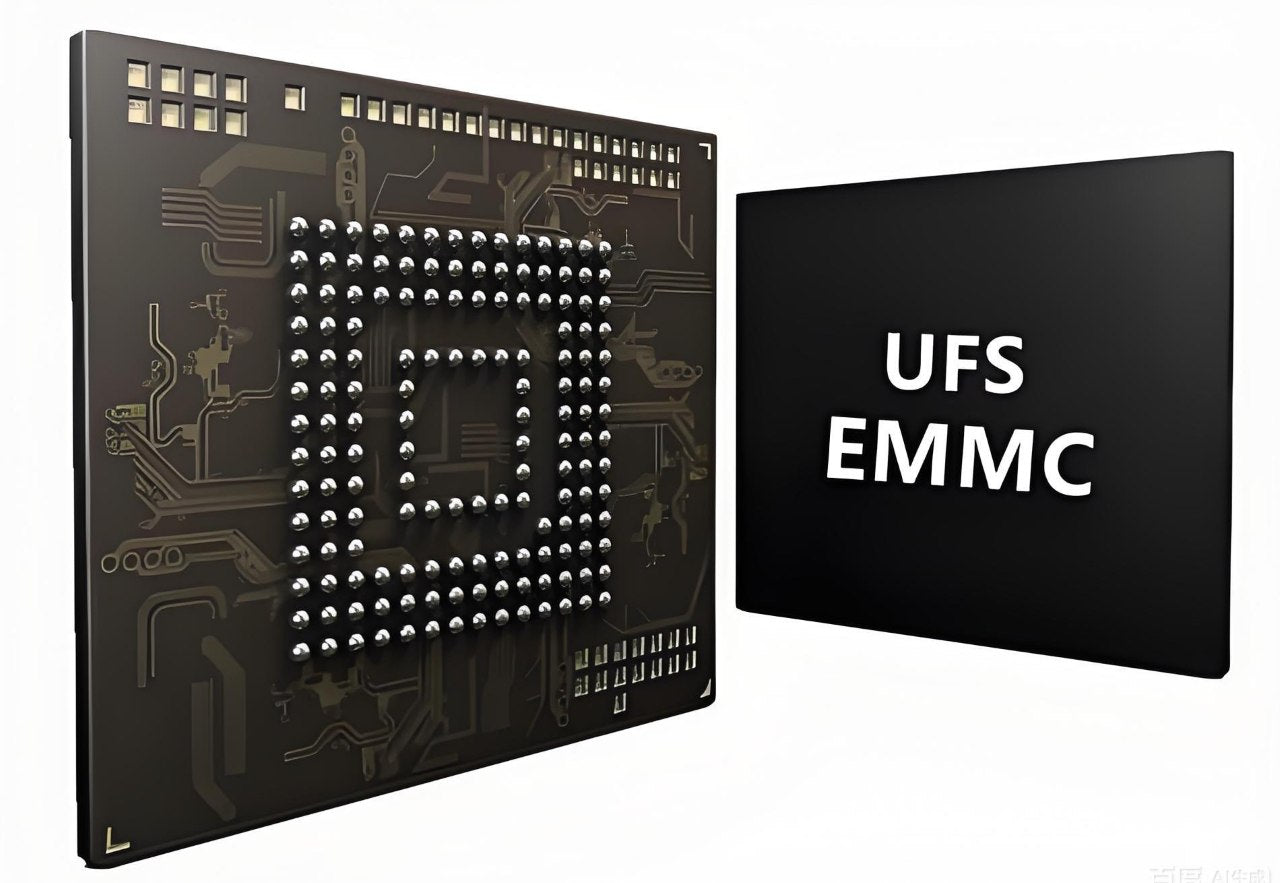
What are eMMC and UFS? What are the differences between eMMC and UFS?
What are eMMC and UFS? EMMC and UFS are both embedded storage interface standards, widely used in mobile phones, tablets, smart TVs, industrial rugged devices, UMPCs, and other devices. Their core function is to connect the main control chip and flash memory chips to enable data read and write operations. The essential differences between the two lie in their bus architecture, transmission protocols, and performance, as detailed below:

1. Introduction to eMMC and UFS
① eMMC (Embedded Multi Media Card) is a widely used storage device, established by the MMC Association. Based on the MMC protocol, it is an embedded storage standard that integrates flash memory chips and a control chip, employing a parallel bus design. eMMC uses a unified standard interface, encapsulating high-capacity NAND Flash and the eMMC controller within a single BGA chip.
Its positioning is as a mid-to-low-end storage solution. It is technologically mature, low-cost, and suitable for devices with low performance requirements, ranging from consumer electronics and industrial applications to automotive-grade applications. With its excellent performance, high reliability, and ease of debugging, it has become an indispensable component in building minimum system architectures.
Common versions: eMMC 4.5, eMMC 5.0, eMMC 5.1 (maximum theoretical bandwidth 400MB/s).
② UFS (Universal Flash Storage) is a solid-state storage device that integrates 3D flash memory and a controller into a JEDEC standard package. It is suitable for applications requiring high-speed performance with low power consumption.
UFS is a next-generation embedded storage standard designed for high-performance needs. Based on the SCSI protocol, it uses a serial bus design and supports full-duplex transmission (simultaneous read and write operations).
UFS is positioned as a high-end storage solution. It boasts advantages such as small size, high storage density, fast transfer rates, and low power consumption. It emphasizes high speed and low latency, making it suitable for flagship mobile phones, high-end industrial equipment, and high-performance UMPCs.
Common versions: UFS 2.1, UFS 3.1, UFS 4.0 (UFS 4.0 has a maximum theoretical bandwidth of 4800MB/s).
2. Core Differences Between eMMC and UFS
① Bus Architecture
eMMC: Parallel bus, only unidirectional transmission (read or write) at a time;
UFS: Serial bus, supports full-duplex transmission (synchronous read and write).
② Transmission Protocol
eMMC: Based on the MMC protocol, simple commands, strong compatibility;
UFS: Based on the SCSI protocol, more efficient commands, supports queued read and write.
③ Read/Write Performance
eMMC: Peak read speed approximately 250–400MB/s, write speed approximately 100–200MB/s;
UFS: Peak read speed up to 1000–4800MB/s, write speed up to 500–2000MB/s.
④ Latency
eMMC: Higher, prone to stuttering under multitasking;
UFS: Extremely low, smoother multitasking.
⑤ Power Consumption Control
eMMC: Higher power consumption, consuming more resources during transmission;
UFS: Lower power consumption, full-duplex design reduces unnecessary waiting.
⑥ Cost and Price
eMMC: Mature technology, low cost;
UFS: Advanced technology, relatively high cost.
⑦ Applicable Devices
eMMC: Mid-to-low-end mobile phones, smart TVs, entry-level rugged devices;
UFS: Flagship mobile phones, mid-to-high-end rugged devices, high-end UMPCs, industrial-grade high-performance embedded devices.
8. Differences in Actual Application Scenarios
eMMC: Suitable for devices with basic functions, such as entry-level tablets, smart speakers, and older industrial barcode scanners, meeting daily storage and file reading needs while offering good value;
UFS: Suitable for scenarios with high speed requirements, such as application launch on flagship mobile phones, 4K video recording, multi-tasking data processing on industrial-grade UMPCs, and loading large software programs, significantly improving device response speed.
eMMC is an economical and practical storage solution, excelling in cost and compatibility; UFS is a high-performance, flagship storage solution, with advantages in high-speed transmission and low latency. As device performance requirements increase, UFS has gradually become the mainstream choice for mid-to-high-end electronic devices, while eMMC is still widely used in entry-level devices.


Laisser un commentaire
Ce site est protégé par hCaptcha, et la Politique de confidentialité et les Conditions de service de hCaptcha s’appliquent.