


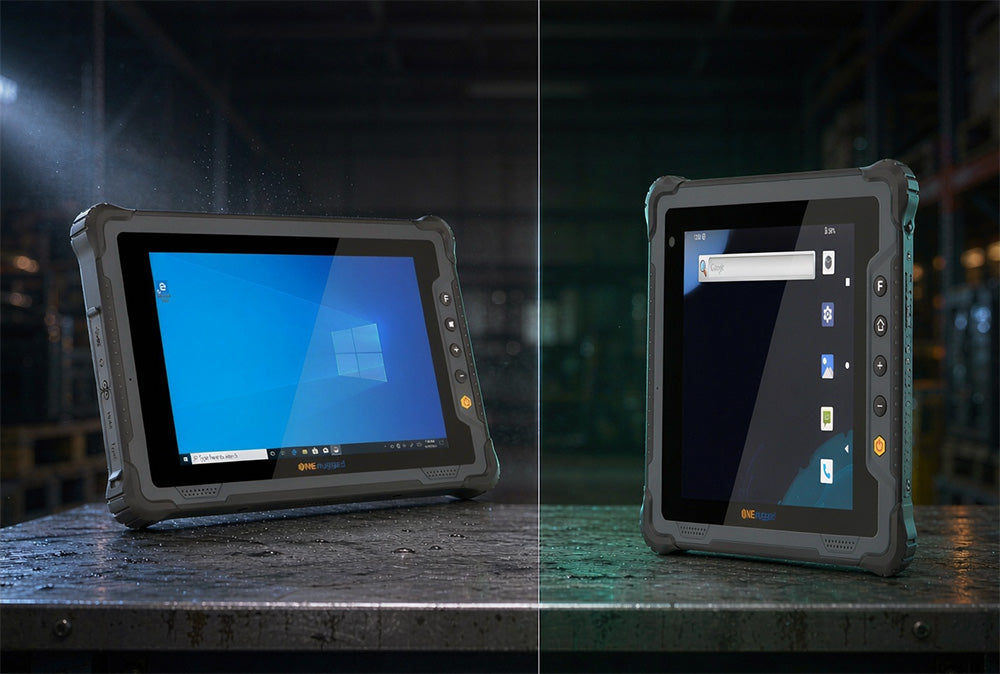
Windows vs Android Rugged Tablet: How to Choose?
The software your team already runs decides the operating system, not the spec sheet. List every application that must work on the device, check which OS each one requires, then pick the platform that covers the entire list. Windows rugged tablets handle desktop and legacy line-of-business software, plus native RJ45 and RS232 ports. Android rugged tablets win on scanning, touch-first apps, battery runtime per gram, and zero-touch provisioning. Brightness, IP rating and drop certification exist on both platforms and should be compared second, never first.
Which OS Should You Choose? Start With Your Software Inventory
When choosing an operating system, one should work backward from the software requirements; this approach is faster and leads to more sound, defensible conclusions. Most Windows-versus-Android debates start with hardware and end in a stalemate, because both platforms now claim the same IP ratings, the same drop tests and the same 700-to-1000-nit panels.
1. List every application that must run on the device: WMS clients, MES terminals, inspection apps, diagnostics software, reporting tools, browsers.
2. Check each application's OS requirement, including who maintains it. One internal .NET tool or one Windows-only diagnostics client settles the question on its own.
3. List every peripheral and protocol the device must talk to: barcode scanners, label printers, RS232 equipment, RJ45 networks, CAN bus, OBD-II dongles, vehicle docks.
Whichever OS covers the entire list is the right choice. If both cover it, decide on battery runtime first, provisioning effort second, and unit price third. Price comes last because a fleet's labour and downtime usually outweigh the per-unit difference across a five-year deployment.
Two questions short-circuit the exercise: does any required application exist only as Windows desktop software, and does the workflow depend on a peripheral with no USB or Bluetooth alternative? A yes to either points to Windows; a no to both points to Android.
Windows vs Android Rugged Tablet: Side-by-Side Comparison
Table 1 — Platform comparison by decision criterion
When Should You Pick Windows?
Choose a Windows rugged tablet when the workload includes any of the following three conditions.
Legacy or internal line-of-business software with no mobile version. ERP clients, .NET tools, Excel-heavy reporting, and desktop browsers running older web applications all assume a desktop runtime. Emulation exists, but it adds a support burden most IT teams will not accept across several hundred units.
Serial and Ethernet peripherals built for industrial PCs. Native RJ45 and RS232 remain the simplest path to legacy equipment. The ONERugged Store M14A, a 14-inch Windows rugged tablet, lists Ethernet and serial ports alongside USB, HDMI and Thunderbolt 4 in its published specification sheet.
Vehicle diagnostics and engineering workflows, where the software ecosystem is Windows-dominated. Diagnostic suites, ECU flashing tools and OEM service software are Windows x86 applications, so the requirement is a desktop-class processor and a full Windows install rather than a mobile OS. The ONERugged Store's M10A meets that host requirement: Windows 11 Pro on a 12th-gen Core i5-1235U or i7-1255U, 16 GB RAM with a 128 GB removable SSD, a native RJ45 port, and a 5000 mAh plus 860 mAh hot-swap battery for full-shift use. The vehicle interface itself — USB, Bluetooth or Ethernet VCI — comes from your diagnostic software vendor, so confirm which interface your suite expects before ordering.

As a current reference point, the M14A pairs a 12th-gen Intel Core i5-1235U with 16 GB RAM, a 14-inch 1000-nit display, IP65 sealing, MIL-STD-810H certification and a hot-swappable battery, listed at US$1,860 on store.onerugged.com when accessed on October 21, 2026 — an anchor for comparing quotes rather than a fixed number.
When Should You Pick Android?
If your team's applications are browser-based or already have modern mobile clients, Android delivers the same workflow on lighter hardware with equivalent rugged certifications.
Scanning-centric operations. Barcode SDKs on Android are mature and hardware scan engines are a standard configuration option rather than a special order. The ONERugged Store H68T Rugged PDA runs Android 14 with an integrated 2D scanner rated for read distances up to 10 meters, according to RuggedPCReview's May 2026 coverage.
Battery runtime per gram. Android's lower power envelope allows a small chassis to run a full shift. The ONERugged Store android rugged tablet M81T weighs 680 g with a 6000 mAh removable battery, Android 14 with GMS, a 700-nit display, IP65 sealing and MIL-STD-810G drop resistance, per ONERugged Store's published specifications. A removable battery matters more than raw capacity on multi-shift sites, because swapping takes seconds and avoids charging downtime.
Faster provisioning at scale. Zero-touch enrolment, QR-code setup, kiosk lockdown and over-the-air updates are native parts of the Android Enterprise stack rather than bolt-on tools. ONERugged Store's Android vehicle computer, the V82T, ships with MDM and OTA support per RuggedPCReview's October 2026 coverage.

Android's advantage concentrates in workflows that are touch-first, scan-heavy and battery-sensitive.
How Long Will Each Platform Be Supported?
An operating-system decision is a multi-year commitment, and the support window depends on the exact edition rather than the OS family. The gap between options on the same platform is larger than the gap between platforms.
Table 2 — Support lifecycle by servicing option
Three purchase actions follow directly from that table. First, ask the vendor to name the exact Windows edition that ships, in writing, because "Windows 11" alone spans a seven-year range. Second, ask for the written end-of-servicing date for that edition, not the date of the OS family. Third, for Android devices, ask for the published security-maintenance release end date and check whether the model appears on Google's recommended device list.
*Why the edition matters: a device that ships Windows 11 Pro is not a problem, but it means your IT team owns annual feature updates for the life of the fleet. Budget that effort explicitly rather than discovering it in year three.
How Do You Manage a Mixed Fleet?
The OS choice determines which console your administrators live in, and mixed fleets are common in practice because many product lines ship both operating systems.
Table 3 — Fleet management tasks by platform
Neither platform is objectively simpler. The practical question is which console your administrators already know, because retraining a fleet team costs more than the licence difference.
One structural advantage is worth checking: if a single product line ships both operating systems in the same chassis size, a mixed fleet can standardise on mounts, docks and batteries. ONERugged Store sells 8-inch rugged tablets in both Windows (M82A) and Android (M81T) versions, so one accessory inventory serves both.
Product Facts Behind the Claims
Table 4 — Published specifications for the models referenced above
Who Each Option Is Not For?
A Windows rugged tablet is the wrong pick when:
Shifts run long and unplugged, since the same size class delivers shorter runtime than an Android device.
The fleet is large and budget-sensitive, because the OS licence is part of every unit's cost.
Your IT team has no Windows endpoint management experience and no appetite to build it.
An Android rugged tablet is the wrong pick when:
A required application exists only as Windows desktop software, with no mobile or browser version.
The workflow depends on serial-only peripherals with no USB or Bluetooth path.
The job is multi-window document work such as complex spreadsheets, CAD viewers or desktop reporting suites.
Honest boundaries matter more than feature lists, because the wrong platform choice usually surfaces in month three rather than week one.
Frequently Asked Questions
Can one rugged tablet run both Windows and Android?
Not on standard hardware. Dual-boot rugged tablets are niche offerings rather than a standard product category, and they complicate certification, warranty and support. The practical route is buying both OS variants across one product line, so a mixed fleet can standardise on accessories and mounts.
Is Android secure enough for enterprise deployment?
Yes, when the manufacturer commits to published update terms in writing. Android Enterprise Recommended requires a stated security-update cadence, a published guarantee end date, and at least one guaranteed major OS upgrade. Verify those commitments before purchase rather than assuming them.
Which OS is better for warehouse scanning?
Android suits most warehouse work. Scan-engine SDKs, camera capture and touch workflows are native to the platform, and battery runtime covers multi-shift picking. Windows remains the answer when the WMS client itself is Windows-only.
Does Windows cost more than Android on a rugged tablet?
Windows units generally quote higher at the same specification level, because the OS licence is part of the device bill of materials. Compare both quotes against your own configuration and include management licensing, because the cheapest unit price is rarely the lowest five-year cost.
Can an existing WMS run on an Android rugged tablet?
Only if it has an Android client or a browser-based interface. This is a common deal-breaker in OS selection, so confirm it with your WMS vendor in writing before evaluating any hardware.
How long will a rugged tablet keep receiving security updates?
It depends on the edition and the manufacturer's published commitment, not on the OS name. Windows 11 ranges from 2027 for Pro to 2034 for IoT Enterprise LTSC 2024, and Android devices must publish an end date under Android Enterprise Recommended. Ask for the date in writing and match it to your replacement cycle.
New to the category? Start with the full overview: What Is a Rugged Tablet? The Complete Guide.
Last Updated: October 27, 2026



Leave a comment
This site is protected by hCaptcha and the hCaptcha Privacy Policy and Terms of Service apply.