



What are the advantages of UFS compared to eMMC?
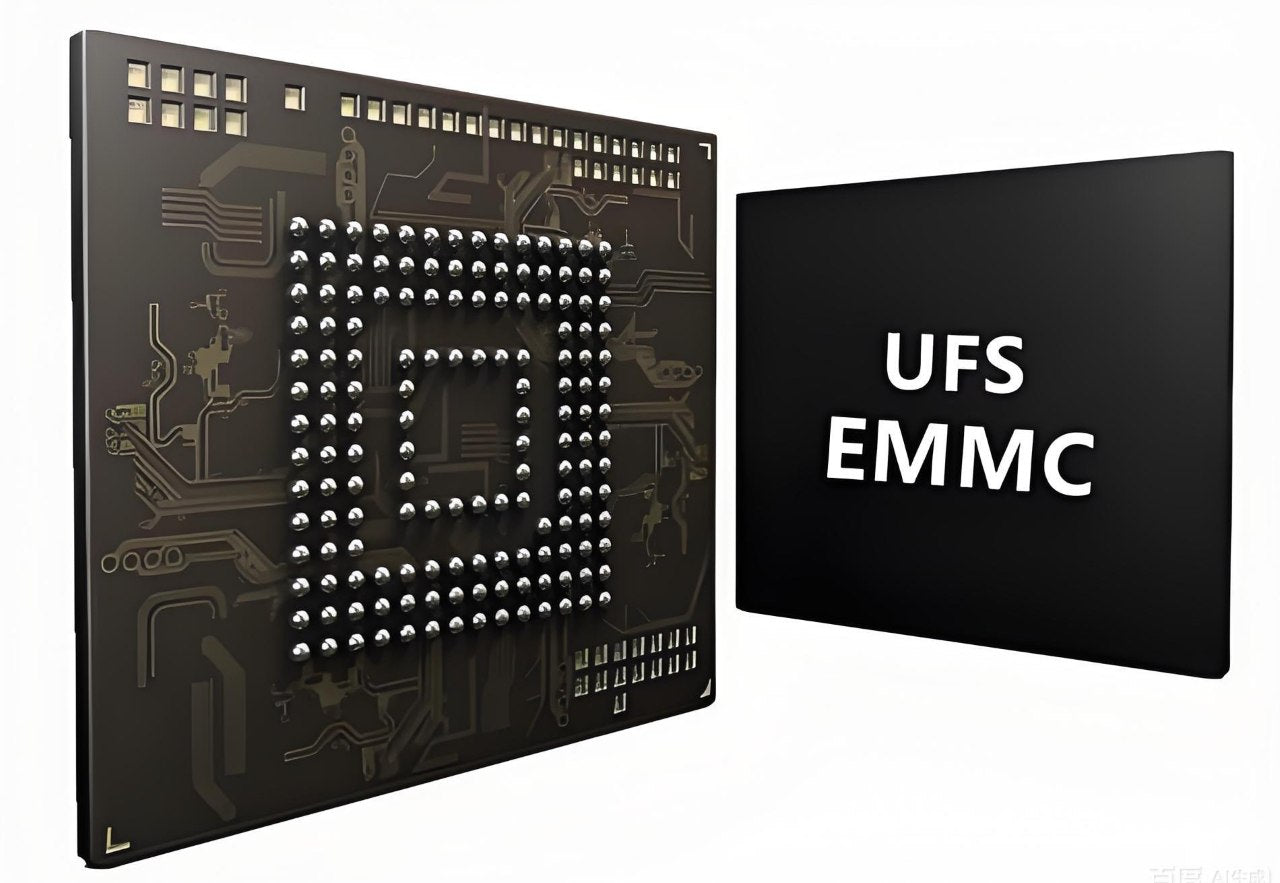
What are the advantages of UFS compared to eMMC? UFS(Universal Flash Storage) has significant advantages over eMMC(Embedded Multi Media Card) in terms of performance, architecture, and future scalability, mainly in the following aspects:

I. Significantly Higher Read/Write Performance
1. Full-Duplex Transmission: UFS supports simultaneous read and write operations (Full Duplex), while eMMC only supports half-duplex, requiring alternating read and write operations. Therefore, UFS has higher bandwidth:
eMMC 5.1: Theoretical bandwidth approximately 400 MB/s
UFS 2.1: Up to 1200 MB/s
UFS 3.1: Up to 2900 MB/s
2. Faster Random Read/Write Performance: UFS has a significant advantage in multi-tasking and high-concurrency scenarios, resulting in faster application startup and system response times.
II. Adopting a More Advanced Interface Protocol
UFS is based on the SCSI architecture and supports: Command Queues and multi-task concurrent processing;
eMMC is based on the MMC protocol, with limited instruction processing capabilities, making it unsuitable for high-concurrency I/O scenarios.
※ In actual use, UFS is closer to the SSD architecture used in PCs.
III. Superior Power Efficiency
UFS supports: Deep Sleep and Hibernate
Under the same workload, UFS, due to its higher transmission efficiency, consumes less power per unit of data, which is beneficial for improving the battery life of mobile devices such as phones and tablets.
IV. More Suitable for High-Performance Applications
1. UFS is particularly suitable for: 5G smartphones, AI computing and image processing, high refresh rate displays, large-scale applications and games, and high-performance industrial terminal equipment.
2. eMMC is more commonly used in: entry-level or cost-sensitive devices, IoT terminals, and basic industrial control equipment.
V. Better Scalability and Future Compatibility
The UFS standard continues to evolve (UFS 2.x → 3.x → 4.0), supporting higher speeds and lower latency, making it easier to meet future system upgrade needs.
VI. Advantages in Structure and Packaging
UFS is often combined with LPDDR to form uMCP (UFS + DRAM). Compared to traditional eMCP (eMMC + DRAM), uMCP is more suitable for high-performance, low-power mobile platforms.
UFS comprehensively outperforms eMMC in speed, concurrent processing capabilities, and energy efficiency, making it the mainstream storage solution for high-performance mobile and industrial devices, while eMMC is more suitable for cost-sensitive applications.


%20has%20significant%20advantages%20over%20eMMC(Embedded%20Multi%20Media%20Card)%C2%A0%20in%20terms%20of%20performance,%20architecture,%20and%20future%20...)
Leave a comment
This site is protected by hCaptcha and the hCaptcha Privacy Policy and Terms of Service apply.