


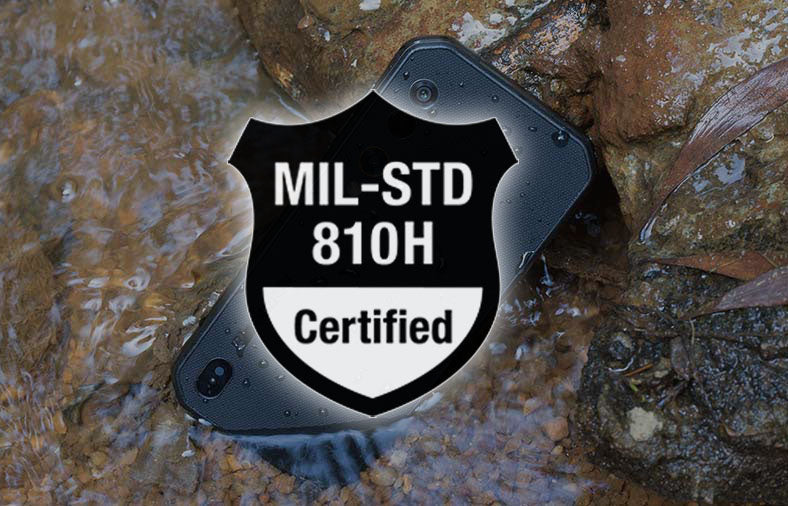
What is MIL-STD-810G? What are the specific test items in the MIL-STD-810G standard?
What is MIL-STD-810G? MIL-STD-810G is a Military Environmental Engineering Considerations and Laboratory Testing Standard issued by the U.S. Department of Defense. Its core purpose is to verify the reliability and durability of equipment in extreme military and industrial environments. This standard includes 28 core test methods, covering multiple dimensions such as mechanical stress, climatic environment, and physicochemical effects. For ruggedized mobile devices like smartphones, the following are the most critical test items and specific requirements:

I. Mechanical Stress Tests (Focusing on Drop and Vibration Resistance)
1. Method 516.6 Impact and Drop Test
This is the most important test for ruggedized phones, simulating accidental drops and collisions. It is divided into several sub-tests:
① Free Fall: Drop the phone from a height of 1.22–3 meters (the target varies depending on the model; most ruggedized phones are tested from 1.8–2 meters) onto a hard concrete or steel plate surface. The test must cover all 6 sides, 8 edges, and 4 corners of the phone to ensure that drops from any angle will not cause the casing to crack, the screen to shatter, or damage to internal components.
② Controlled Impact: A controlled impact test uses a weight of specified mass or an impact hammer to strike critical parts of the phone (such as the screen, frame, and battery compartment) at a specific speed to verify the structure's impact resistance.
2. Method 514.6 Vibration Test
Simulates the continuous vibration environment of the device near transportation vehicles (vehicles, airplanes) and industrial equipment. This includes:
① Random Vibration: Applying a certain acceleration (typically 1–4g) within a frequency range of 5–2000Hz for several hours to verify whether components such as the motherboard, battery, and interfaces are loose, detached, or malfunction.
② Sinusoidal Vibration: Fixed-frequency or swept-frequency vibration to simulate the resonance effects in specific scenarios, ensuring the phone remains stable under continuous vibration.
3. Method 527.1 Acceleration (High-Speed Motion) Test
Simulating scenarios where the device accelerates and decelerates at high speeds with its carrier, continuous acceleration (e.g., 10–20g) is applied to test the fixation strength of internal components, preventing issues such as battery displacement and chip desoldering.
II. Climate and Environmental Tests (Adaptation to Extreme Temperature and Humidity)
1. Method 501.5 High and Low Temperature Operating Test
① High Temperature Test: The phone is placed in a constant temperature chamber at 55°C–70°C for several hours and continuously operated (e.g., making calls, taking photos, and connecting to the internet) to verify whether the screen, battery, and processor experience lag, shutdown, or performance degradation under high temperatures.
② Low Temperature Test: The phone is placed in a low temperature chamber at -20°C–-40°C for several hours and its core functions are operated to ensure that the lithium battery does not shut down due to low temperatures, the screen does not crack due to low temperatures, and the touch function remains normal.
2. Method 502.5 High and Low Temperature Storage Test
Simulating long-term storage in extreme environments, the phone is powered off and placed in an environment of -55°C (low temperature) or 85°C (high temperature) for 24–72 hours. After being removed and allowed to return to room temperature, the phone is checked for issues such as casing deformation, component failure, and screen fogging.
3. Method 507.5 Humidity Test
① Constant Humidity: The phone is placed in an environment of 95% RH (relative humidity) and 30°C for 10 consecutive days to verify the casing's sealing performance and prevent short circuits caused by moisture on the internal circuit board.
② Alternating Humidity and Heat: Temperature and humidity are cycled between -20°C and 60°C to simulate environments with large day-night temperature differences and high humidity, testing the phone's resistance to condensation.
4. Method 509.5 Salt Spray Test
Simulating the corrosive environment of coastal, marine, or saline-alkali areas, the phone is continuously sprayed with a 5% concentration of sodium chloride salt spray for 24–96 hours to test the corrosion resistance of the casing and metal interfaces (such as USB-C and SIM card slot), preventing rust and poor contact.
III. Physical and Chemical Influence Tests
1. Method 510.5 Sand and Dust Test
A core verification corresponding to the IP dust resistance rating, the phone is placed in a test chamber containing sand of a specific particle size, subjected to continuous airflow or vibration to simulate the dusty environment of a desert or construction site. After the test, the phone's internal components are checked for dust ingress, and the camera, earpiece, and speaker are checked for blockage, and whether all functions are normal.
2. Method 517.1 Explosive Atmosphere Test
Simulating flammable and explosive environments such as coal mines and oil fields, the phone is placed in a confined space containing flammable gases such as propane and hydrogen, and its core functions (calls and charging) are run to verify whether the device will generate electrical sparks that could cause an explosion. This is a crucial test for industrial explosion-proof rugged phones.
3. Method 521.1 Liquid Immersion Test
This test assists in verifying the IP waterproof rating. The phone is immersed in 1–5 meters of clean water for at least 30 minutes (specific parameters depend on the target IP rating of the model). After removal, it is checked for water damage and whether charging, call, and other functions are normal. Some high-rated models also undergo seawater immersion testing to verify corrosion resistance and waterproofing capabilities.
IV. Other Specific Tests
1. Method 528.1 Solar Radiation Test
Simulating the intense sunlight environment of a tropical region, the phone is exposed to solar radiation (approximately 1120 W/m²) using a xenon lamp for several hours to test the screen's resistance to UV aging, whether the casing fades or deforms, and whether the battery overheats and runs out of control due to prolonged exposure to sunlight.
2. Method 513.6 Acceleration (Collision) Test
Simulating severe collisions during transportation, the phone is placed in its packaging on a collision testing machine and repeatedly impacted at specific speeds and accelerations to verify the overall device and packaging's resistance to transportation damage.
V. Key Notes
1. MIL-STD-810G is a voluntary certification. Manufacturers can choose the testing items based on product positioning; not all models will complete all 28 tests.
2. The test results must meet the requirement of "100% normal device function after the test, with no permanent damage" to pass the certification. This is the core reason why rugged phones that pass this standard are more durable than ordinary phones.


Leave a comment
This site is protected by hCaptcha and the hCaptcha Privacy Policy and Terms of Service apply.