

ONERugged A14 14-inch Rugged AI Workstation | AMD Ryzen AI 7, OCuLink, Dual GbE
Let's Talk!
- Bulk Order Price
- 24-Hour Business Response
- 1-Year Warranty
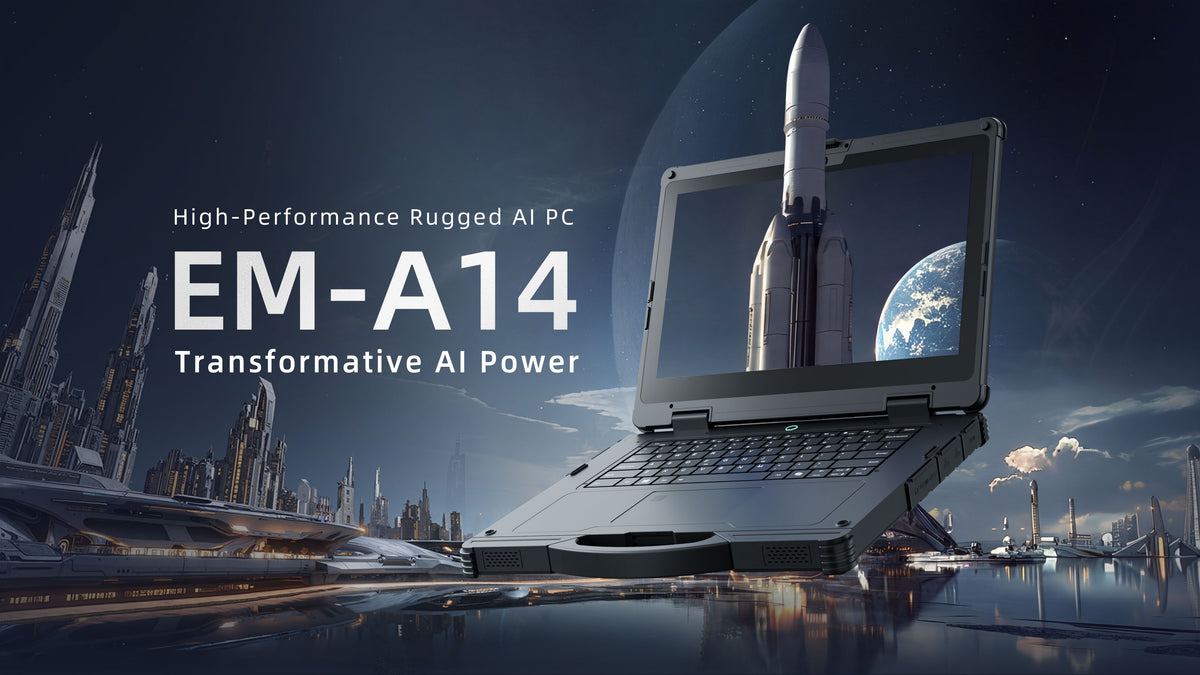
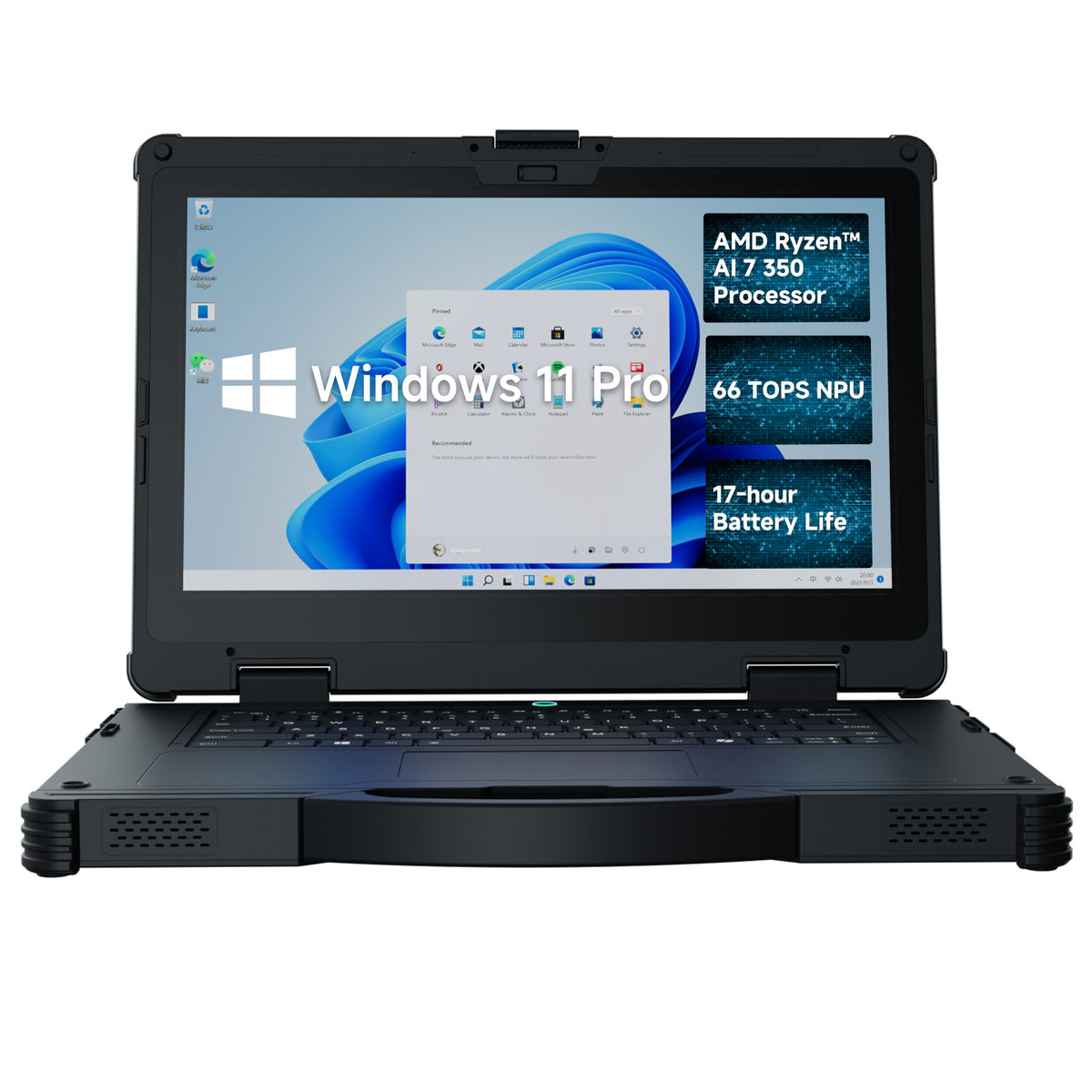
The A14 is a 14-inch rugged AI workstation built for the work that used to require a desk. An AMD Ryzen AI 7 350 platform puts 66 TOPS of on-device compute in the chassis, OCuLink opens a PCIe channel to an external GPU or capture device, and dual Gigabit Ethernet plus a native RS232 port connect it to the networks and instruments that field engineers actually work with.
- 66 TOPSRyzen AI 7 350 platform AI compute, including a dedicated NPU
- OCuLinkPCIe over a single cable, for GPU or capture hardware
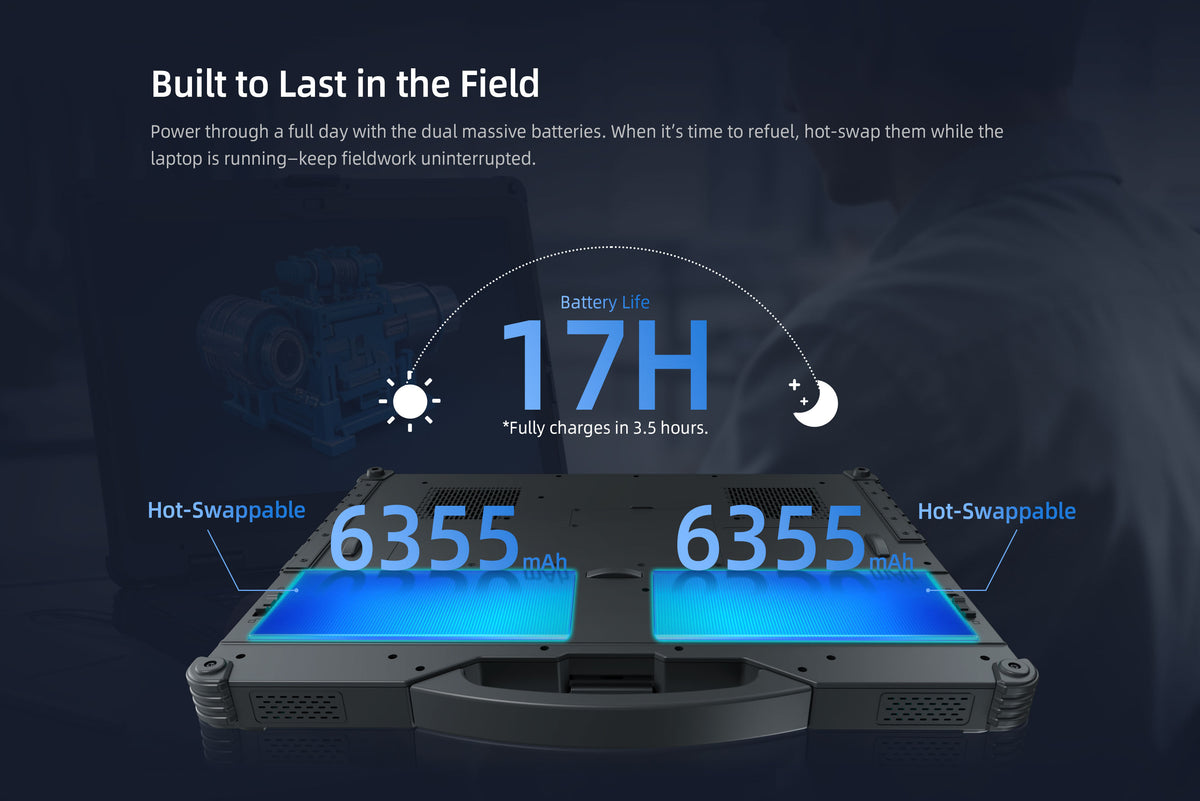
- 17 hDual 6355 mAh packs, both hot-swappable
Key features
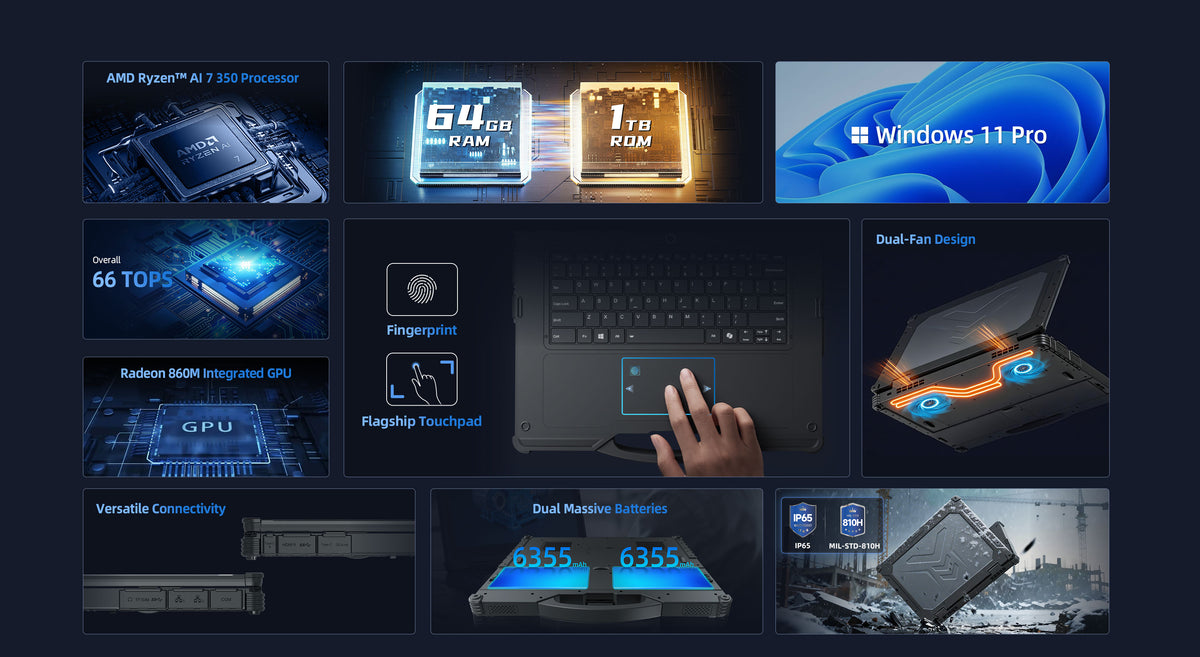
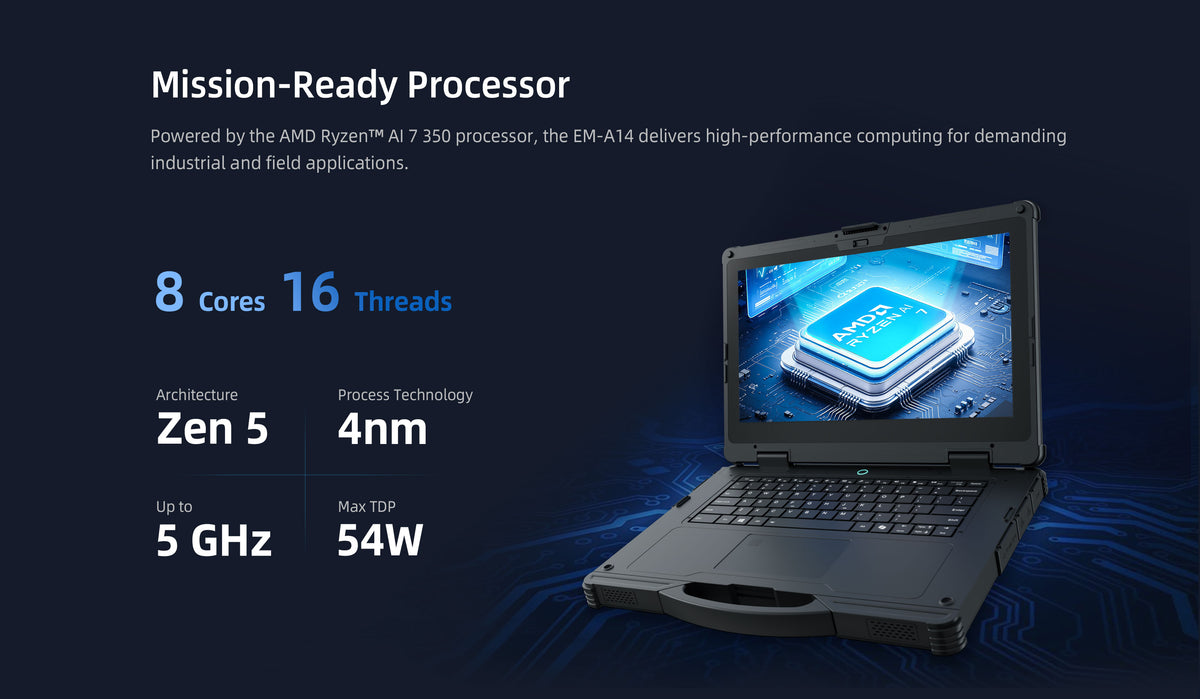
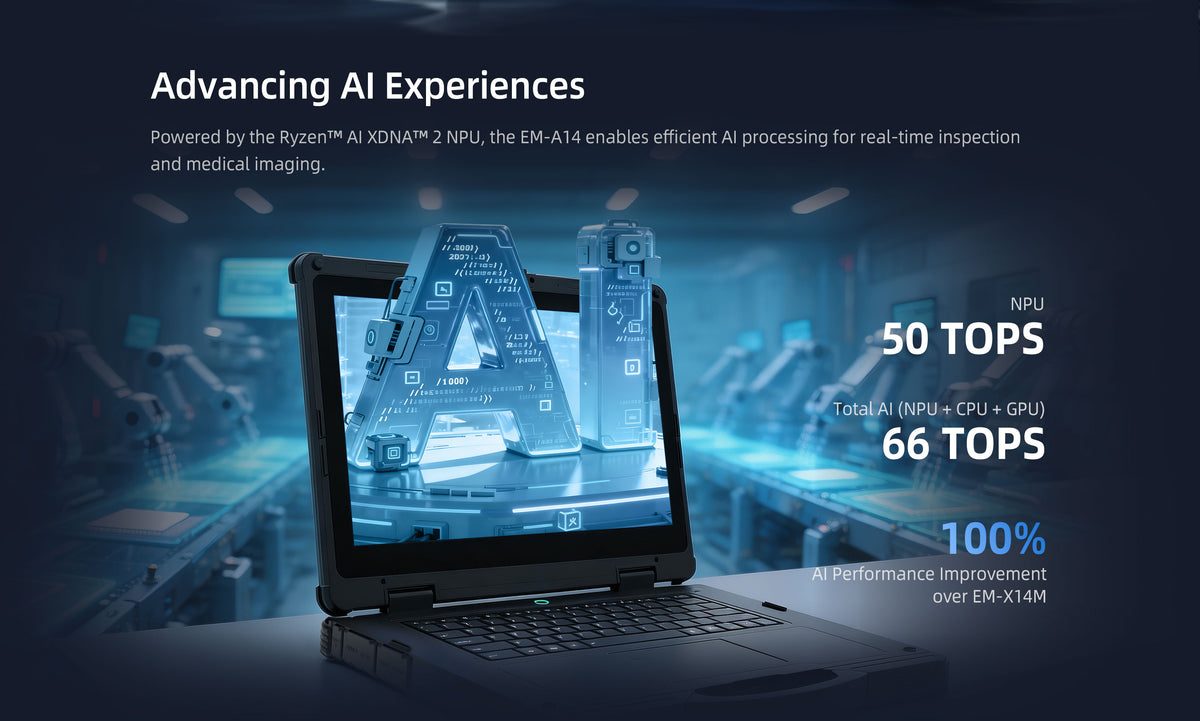
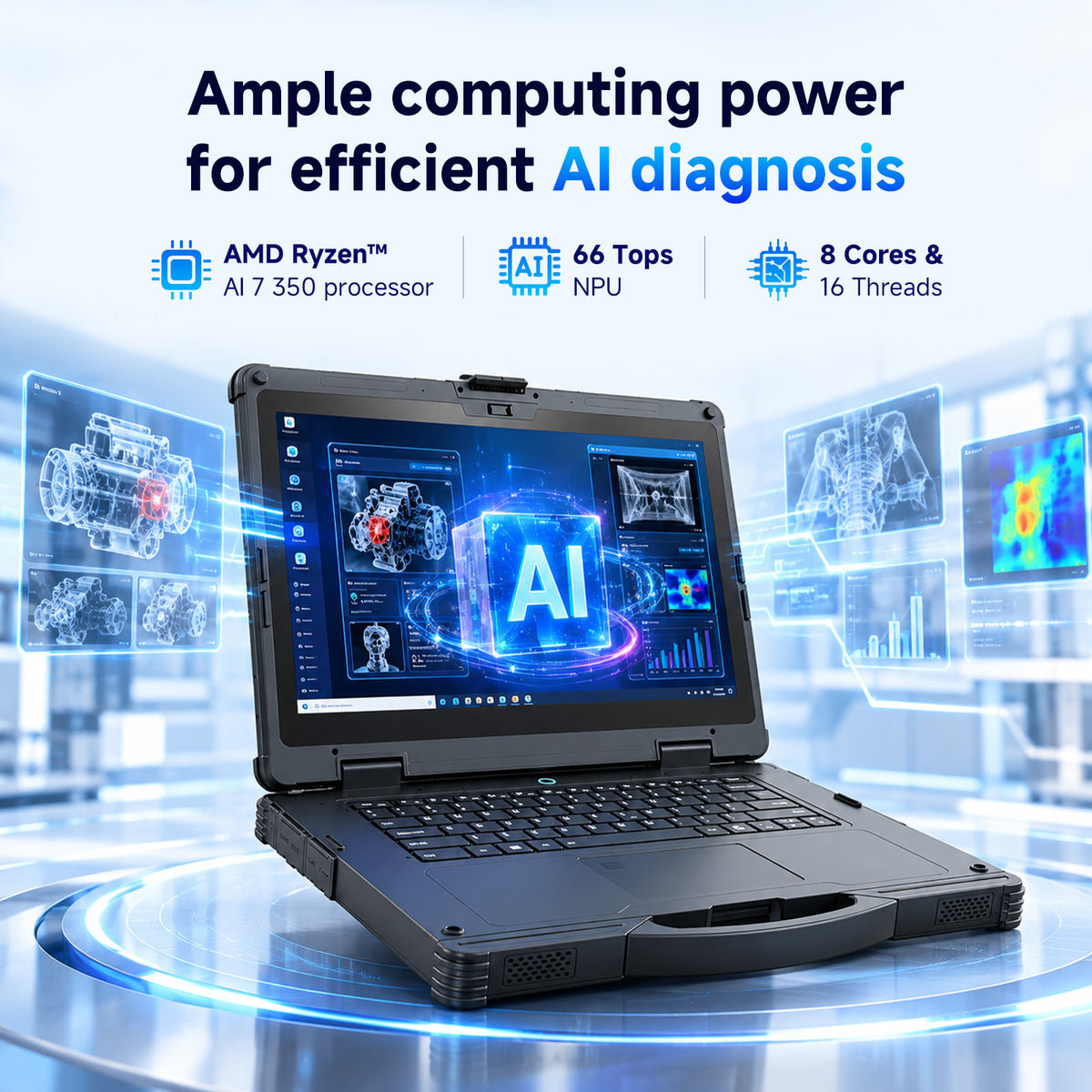
- A dedicated NPU, not just a fast CPU. The AMD Ryzen AI 7 350 pairs 8 cores / 16 threads running to 5.0 GHz with Radeon 860M graphics and an on-die AI engine, for 66 TOPS of platform AI compute — enough to run vision inspection, OCR or a small model at the point of capture instead of uploading footage to a server and waiting for the result.
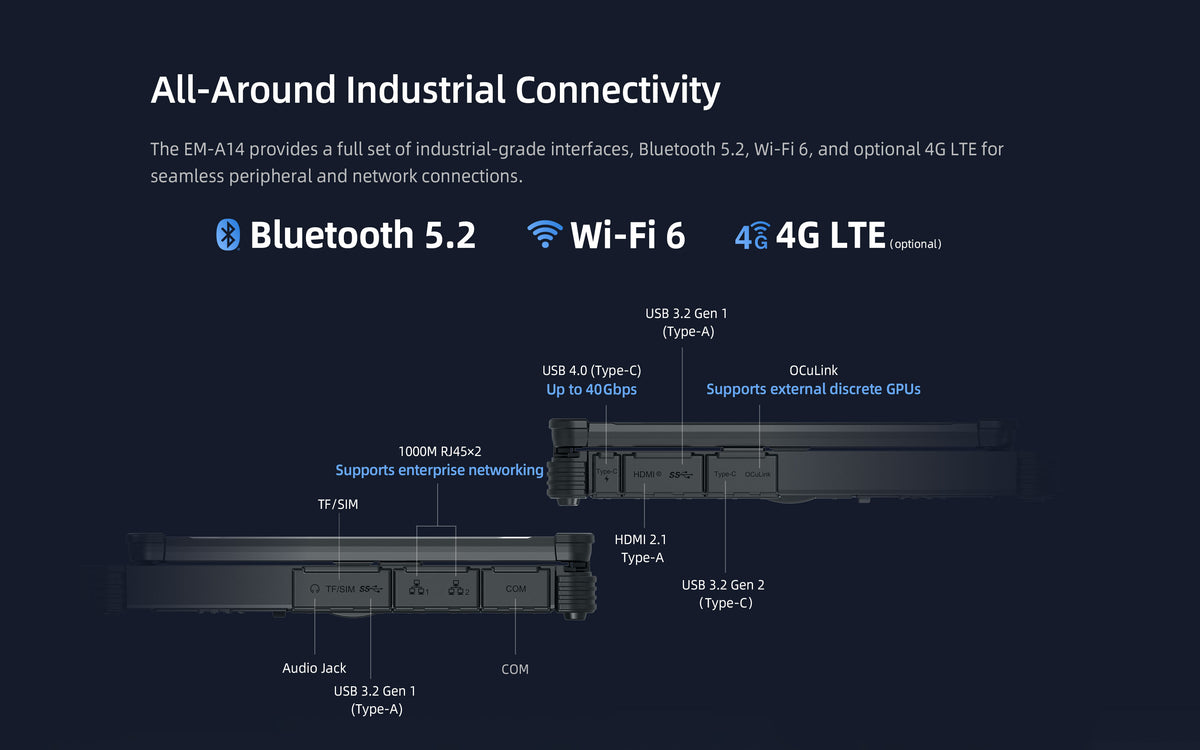
- OCuLink. A PCIe channel over a cabled connector. Attach an external GPU, a capture card or a high-speed NVMe enclosure when a job needs more than the chassis can hold — and unplug it when it does not.
- Dual Gigabit Ethernet. Two independent RJ45 ports let you keep the corporate / machine network and the OT or instrument network physically separate, with no dongle and no VLAN negotiation on site.
- Native RS232. A real D-sub 9 serial port for PLCs, weighbridges, legacy instruments and vehicle interfaces that never moved to USB. No USB-to-serial adapter to lose, no driver to install.
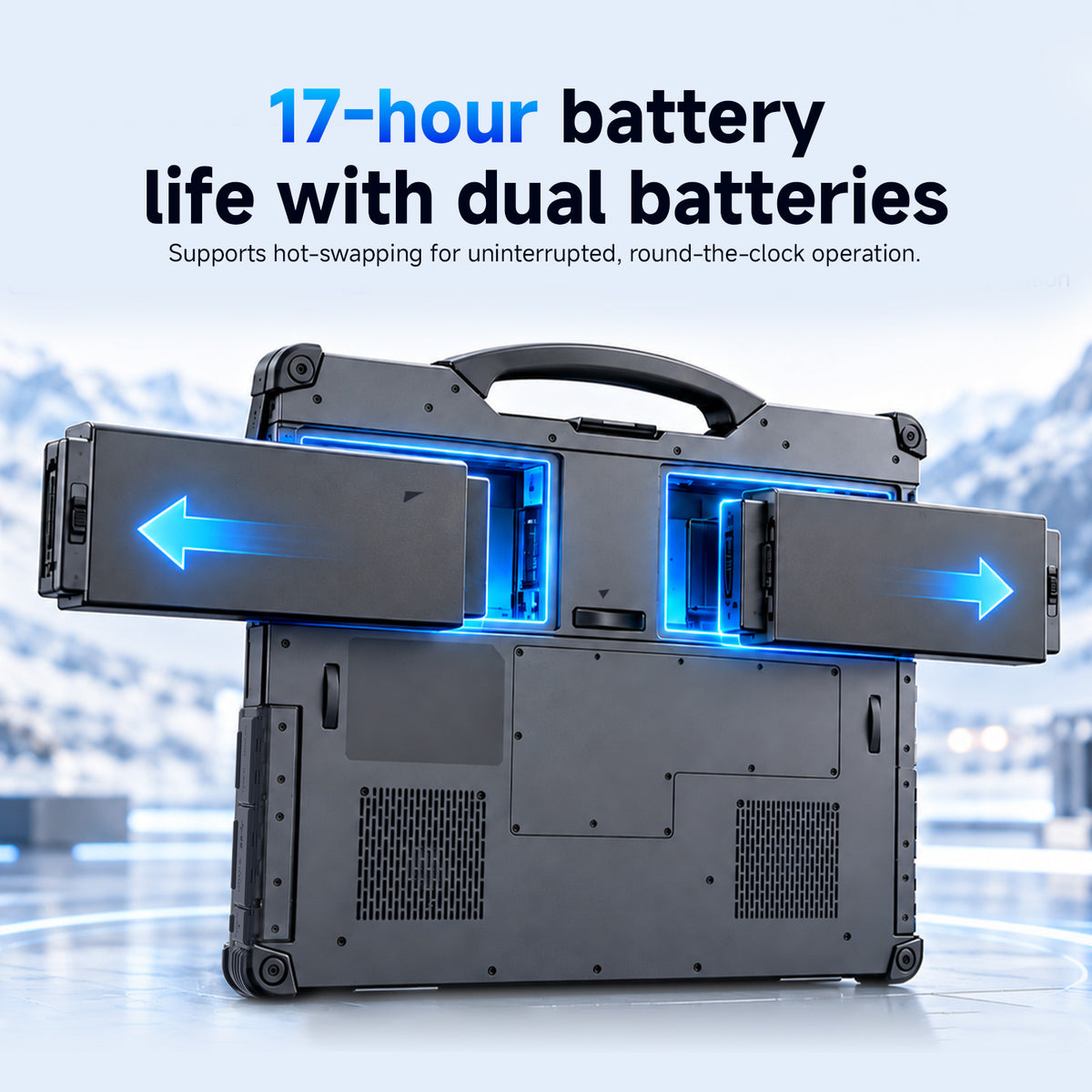
- Both battery packs hot-swappable. Two 6355 mAh packs (11.61 V, ≈73.8 Wh each, ≈147.6 Wh total) deliver up to 17 hours with both installed, and either pack can be swapped while the machine keeps running on the other. A scan, a diagnostic session or a long file transfer is never interrupted by a battery change.
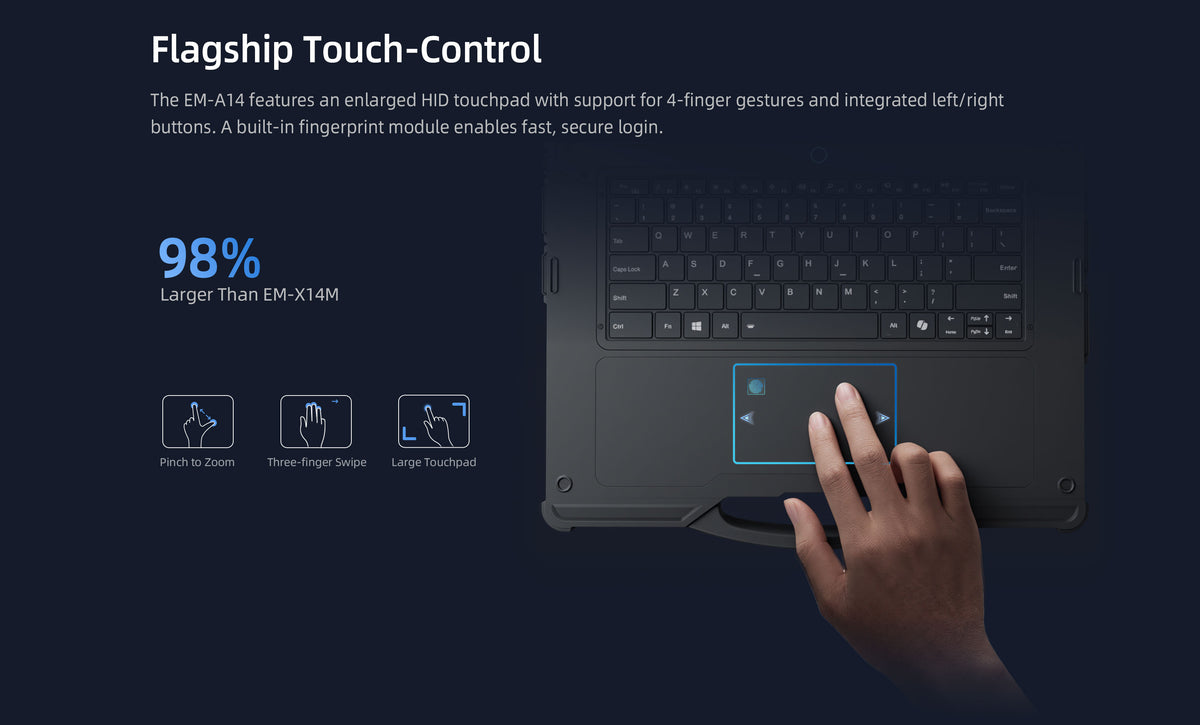
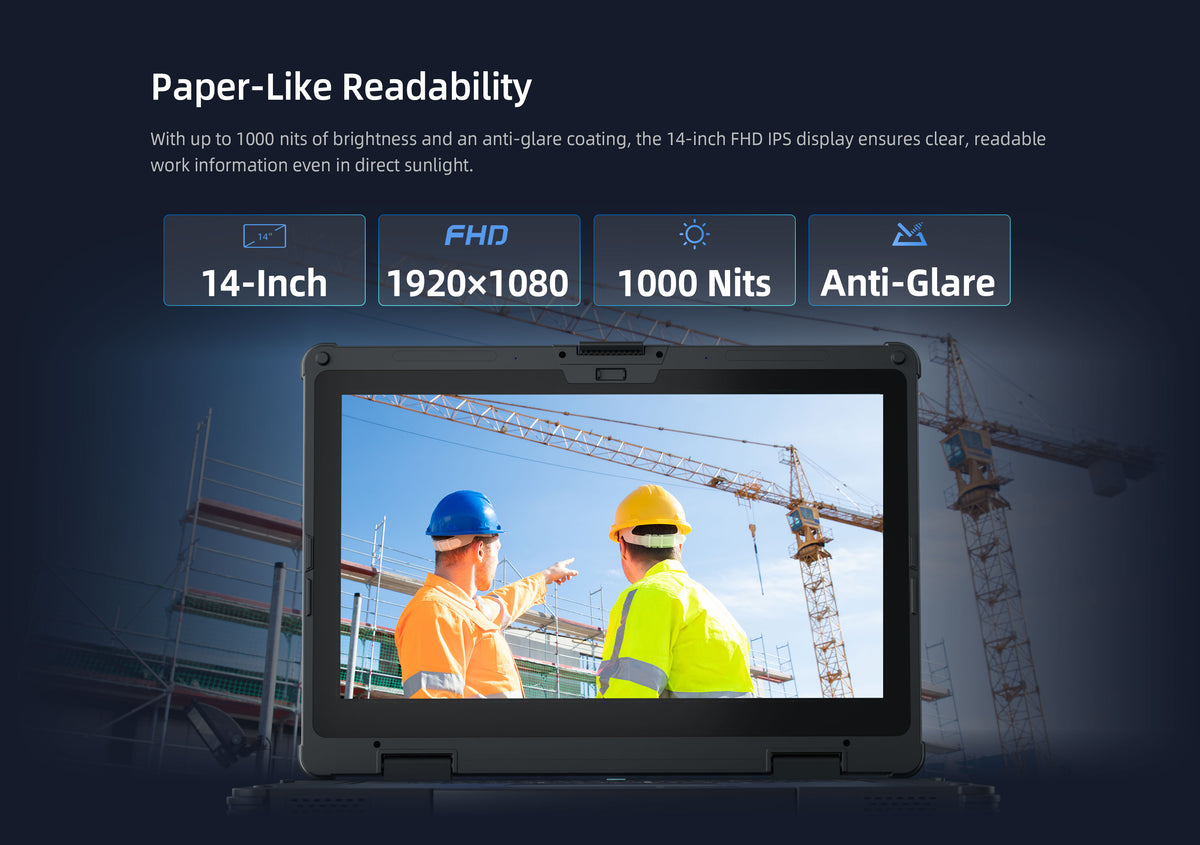
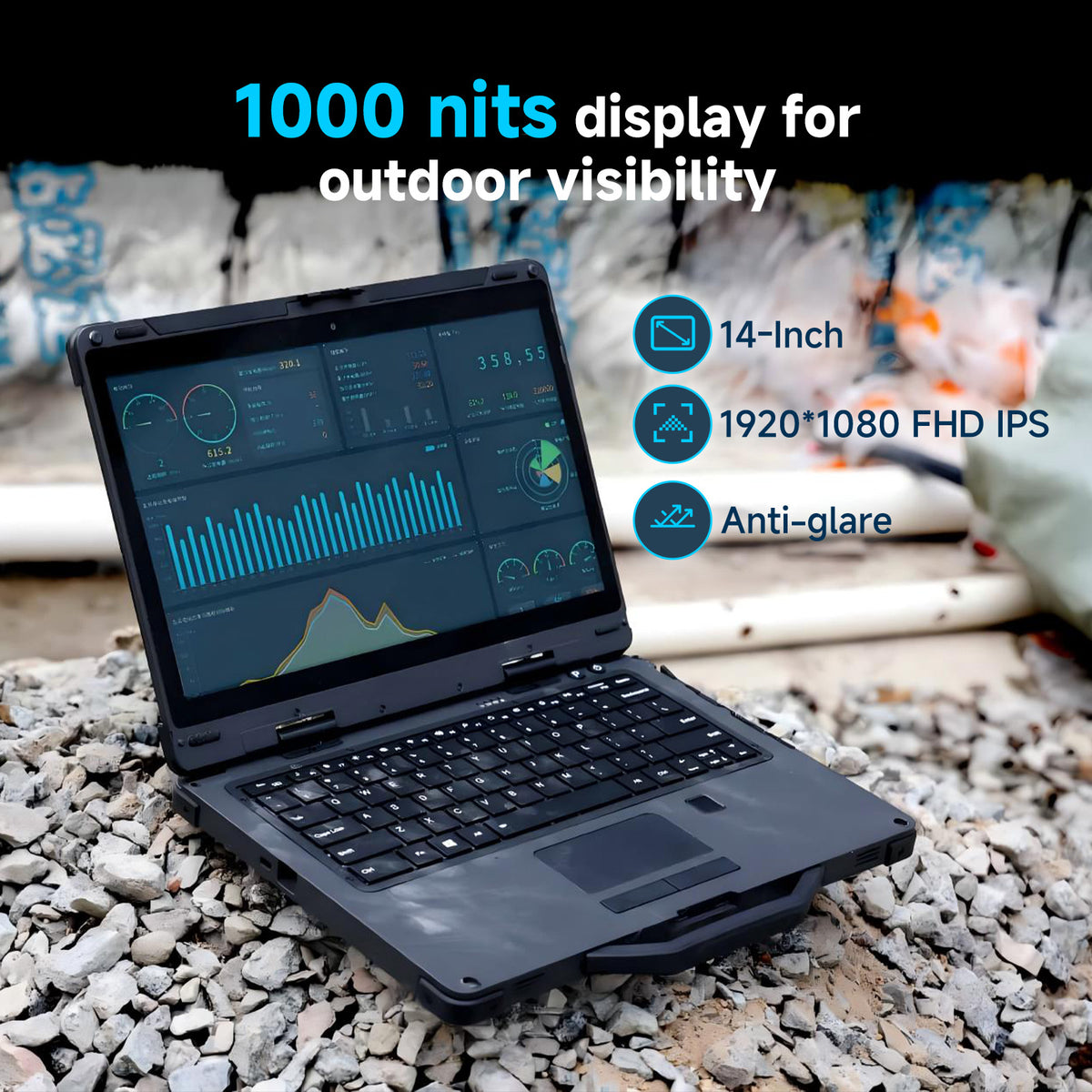
- 14-inch 1000-nit touch display. FHD 1920 × 1080, anti-glare, multi-point gesture touch, with the fingerprint reader integrated into the same module — technicians can fill in a form or sign in without reaching for a keyboard or an external reader.
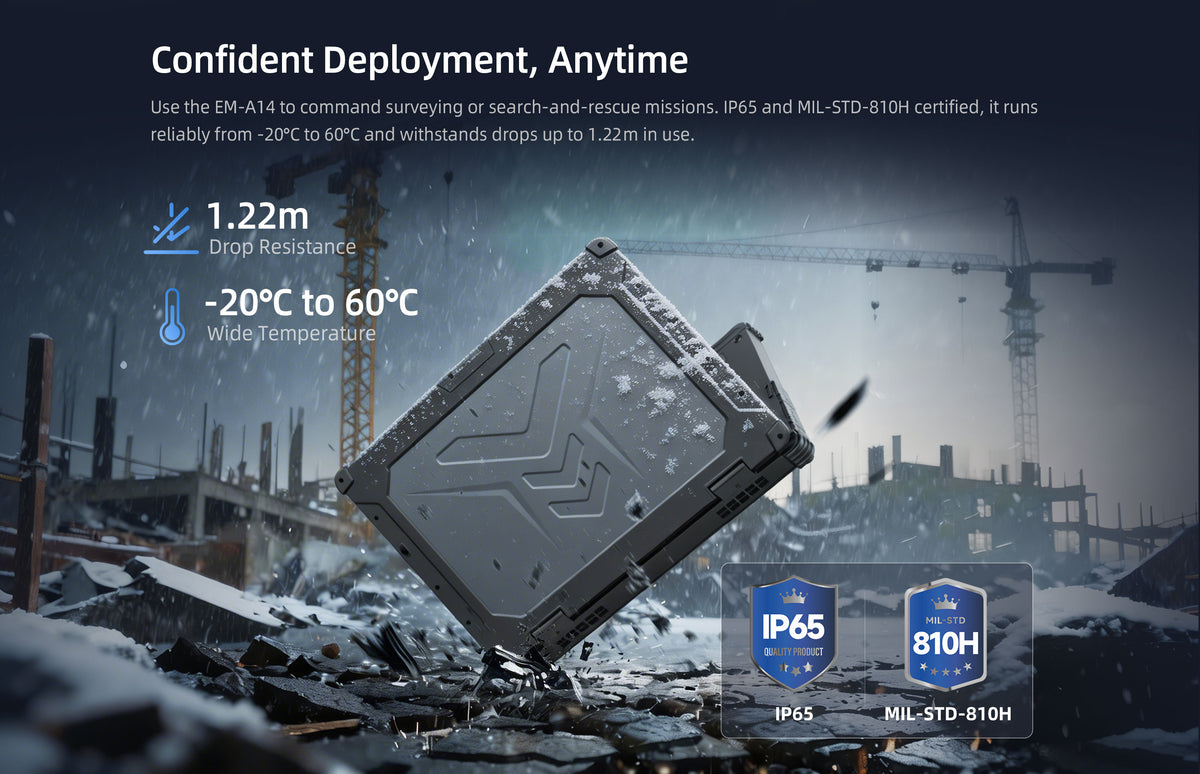
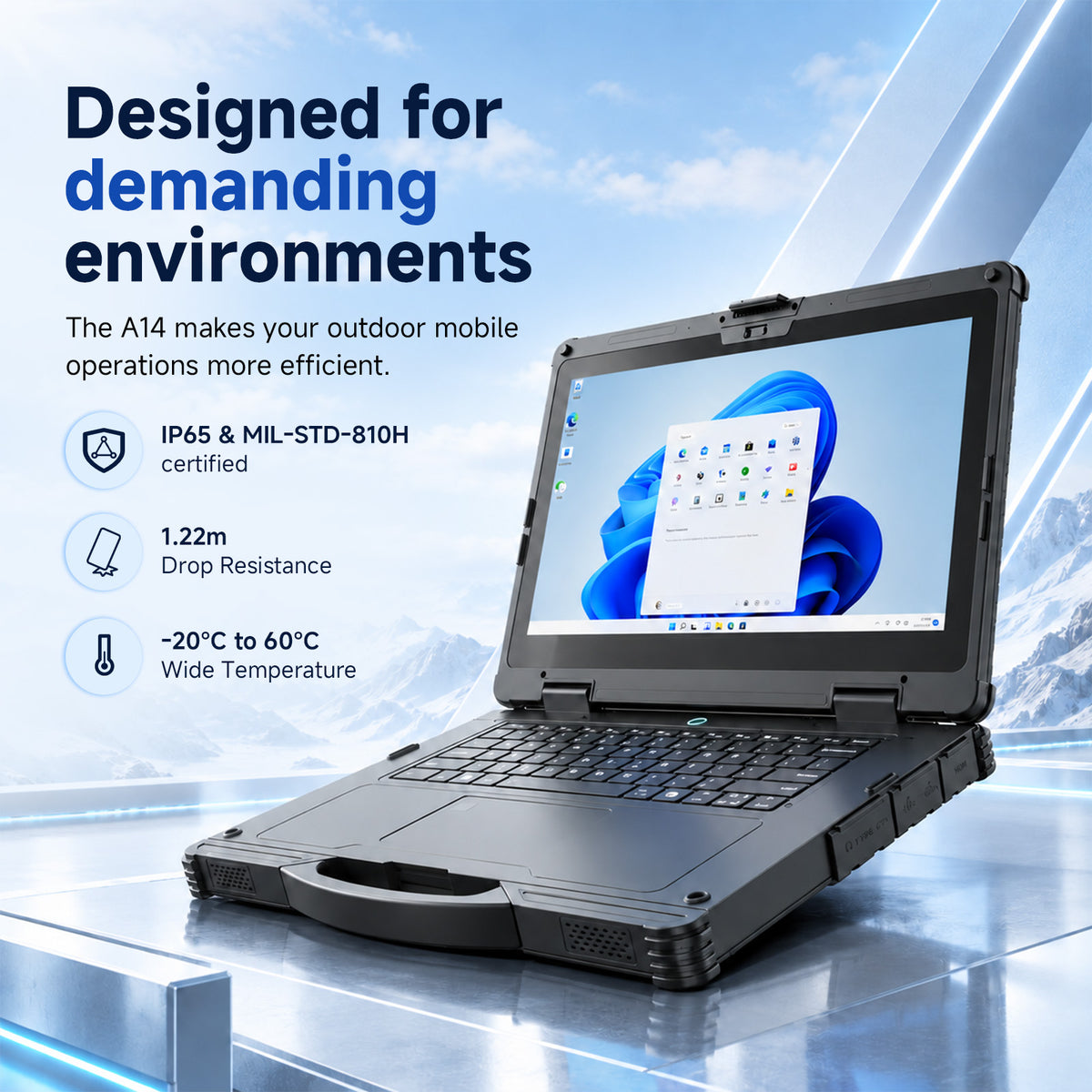
- IP65 and MIL-STD-810H. Sealed against dust and water jets, rated for 4 ft / 26 drops across every face, edge and corner, ESD ±8 kV contact and ±15 kV air, and operating from -20 °C to 60 °C.
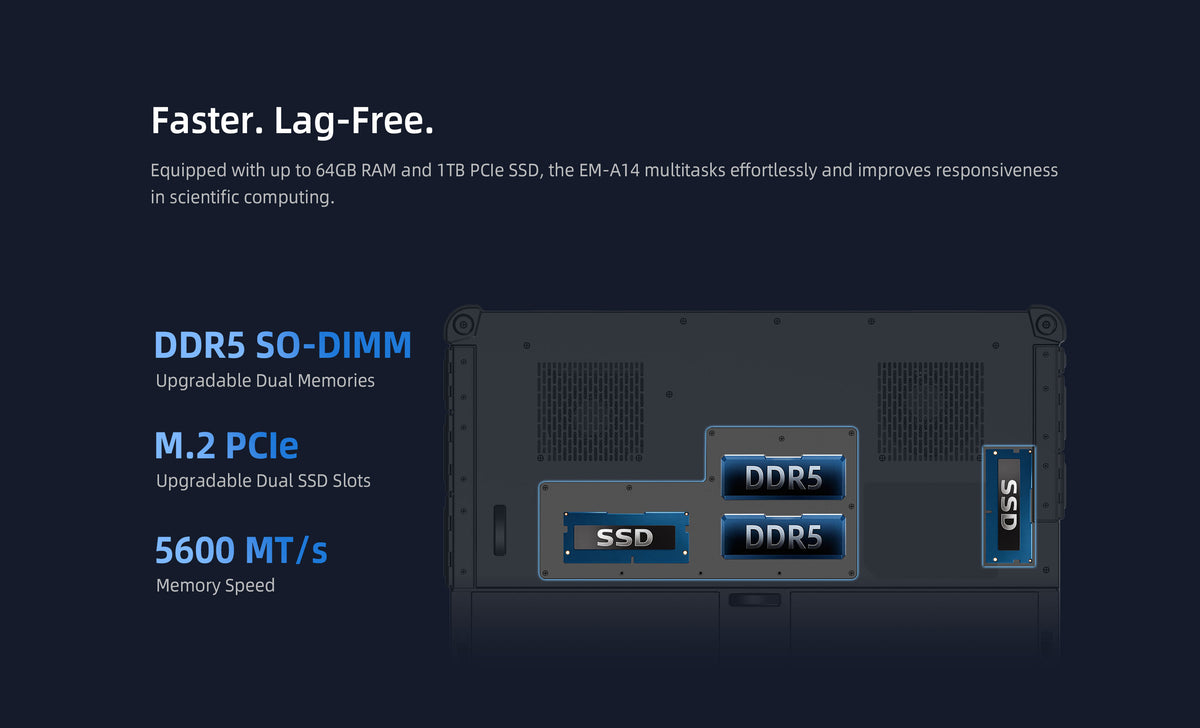
- 64 GB DDR5 and dual NVMe. Dual SO-DIMM slots expand to 64 GB, and an optional second NVMe drive keeps the operating system and the working dataset on separate disks — useful when a survey or a video log fills a drive mid-shift.
Why a rugged AI workstation instead of a rugged laptop
A rugged laptop is designed to survive the trip to site. A rugged AI workstation is designed to finish the analysis there. The difference is measurable: a 4K inspection frame or a point cloud is hundreds of megabytes, and sending it over a site uplink to a cloud model takes minutes you may not have — and in some facilities the data is not allowed to leave the fence at all.
The A14 keeps that loop local. 66 TOPS of platform compute handles inference, preview and pre-processing on the machine; 64 GB of memory and a second NVMe give a working dataset room; OCuLink lets you attach a discrete GPU on the days the workload grows. Nothing about the workflow requires a desk, a server room, or a stable internet connection.
It is also a 14-inch machine at 2.85 kg. That is heavier than an office ultrabook, and deliberately so — the mass is what holds a 1000-nit panel, two hot-swappable packs and a sealed chassis with this much I/O in one piece.
OCuLink and the I/O field engineers ask for
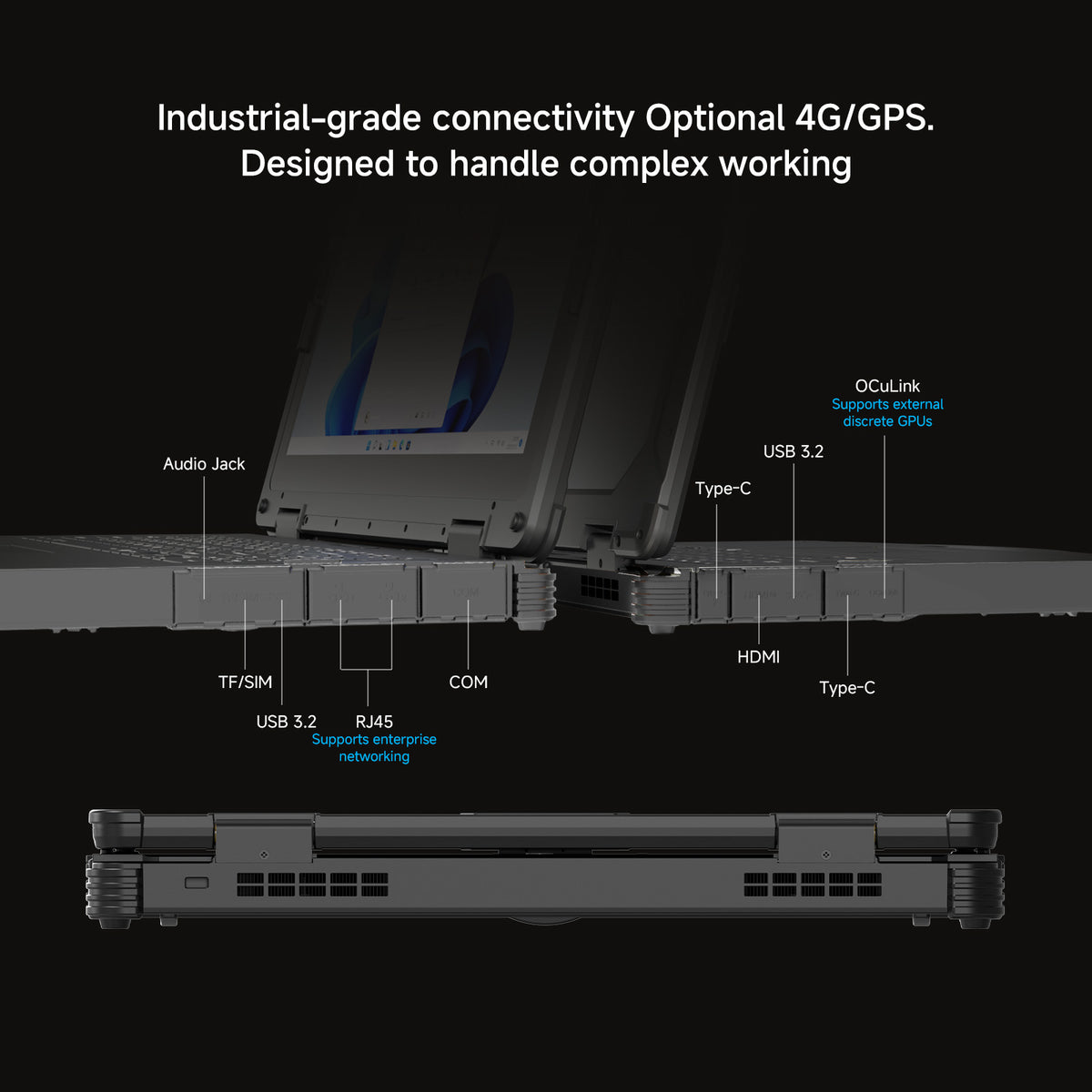
Most rugged notebooks are sealed at the port level: one RJ45, one serial port if you are lucky, and a USB-C hub to make up the rest. The A14 exposes the ports that site work actually terminates in.
- OCuLink ×1 — PCIe over a cable. External GPU, capture card, or a fast external array.
- RJ45 Gigabit ×2 — separate machine network and instrument network, without a switch or a dongle.
- RS232 (D-sub 9) ×1 — PLCs, scales, controllers, vehicle interfaces.
- USB4 ×1, USB-C 3.2 Gen 2 ×1, USB-A 3.2 Gen 1 ×2 — docking, high-speed storage, and the usual peripherals.
- HDMI 2.1 ×1 — a second display for a temporary workstation in a control room or a command vehicle.
- SIM ×1, SD ×1, 3.5 mm audio ×1 — cellular data without an external modem, camera cards straight in, headset for a noisy floor.
Charging runs over USB-C PD at 100 W (20 V / 5 A) with a 100–240 V input, so a single universal adapter covers a vehicle, a site office and a hotel room.
Full technical specifications
| Operating system | Windows 11 Pro / Home / IoT Enterprise (LTSC optional) |
|---|---|
| Processor | AMD Ryzen™ AI 7 350 — 8 cores / 16 threads, 16 MB cache, up to 5.0 GHz, 66 TOPS platform AI |
| NPU | Dedicated on-die AI engine, included in the 66 TOPS platform total |
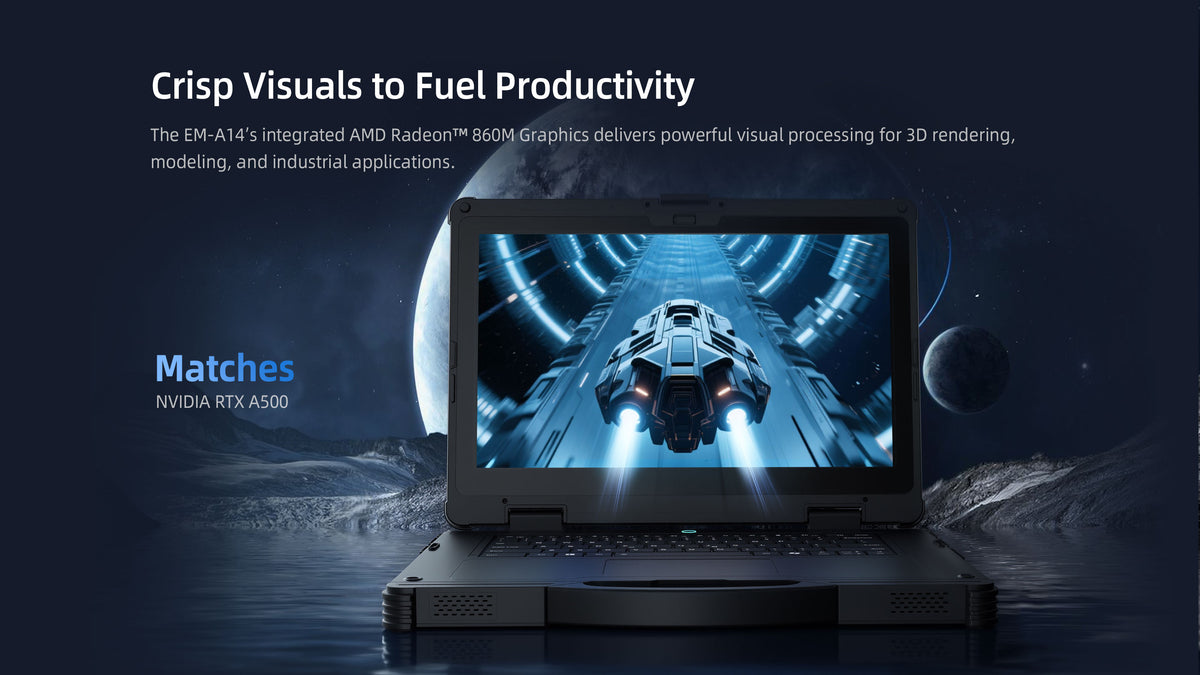
| Graphics | AMD Radeon™ 860M |
| Memory | 16 GB DDR5-4800 (dual SO-DIMM, expandable to 64 GB) |
| Storage | 256 GB NVMe PCIe SSD; optional 512 GB / 1 TB; optional second NVMe SSD |
| Display | 14.0" FHD 1920 × 1080, 1000 nits, anti-glare, multi-point gesture touch |
| I/O ports | USB-A 3.2 Gen 1 ×2 · USB-C 3.2 Gen 2 ×1 · USB4 ×1 · OCuLink ×1 · HDMI 2.1 ×1 · RJ45 GbE ×2 · RS232 (D-sub 9-pin) ×1 · 3.5 mm audio ×1 · SIM ×1 · SD ×1 |
| Wireless | Wi-Fi 6 (802.11ax) M.2 · Bluetooth 5.2 · optional 4G LTE · optional GPS / GLONASS |
| NFC | Not supported |
| Battery | Li-ion 11.61 V / 6355 mAh ×2 (≈73.8 Wh each, ≈147.6 Wh total), both packs hot-swappable; up to 17 hours with both packs installed* |
| Charging | USB-C PD 100 W (20 V / 5 A), 100–240 V input; separate RTC 3 V / 210 mAh |
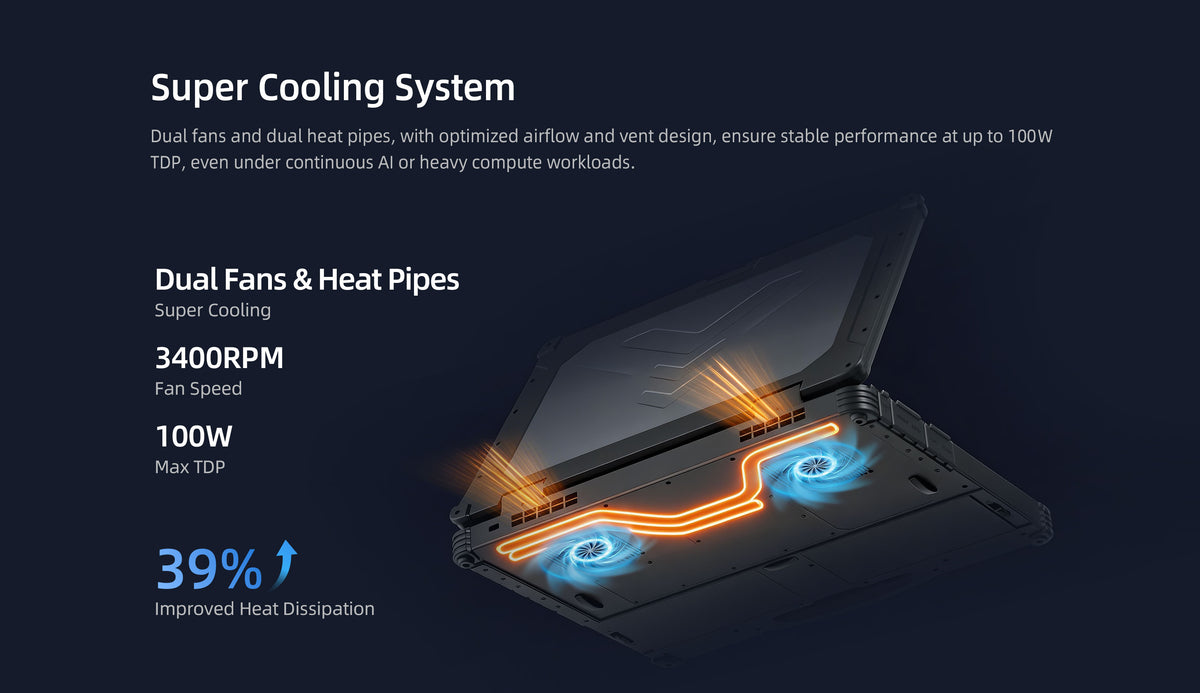
| Cooling | Dual fan |
| Audio | 2 W speaker ×2, integrated microphone |
| Camera | 5.0 MP front camera (fixed focus) |
| Keyboard | US layout standard; DE / FR / EU optional; touchpad; power key |
| Durability | MIL-STD-810H certified · IP65 · 4 ft / 26 drops (each face, edge and corner) · ESD ±8 kV contact / ±15 kV air |
| Operating temperature | -20 °C to 60 °C (-4 °F to 140 °F) |
| Storage temperature | -30 °C to 70 °C (-22 °F to 158 °F), 95% RH non-condensing |
| Security | fTPM 2.0 · fingerprint reader integrated in the touch display · Kensington lock slot |
| Dimensions | 356 (L) × 269 (W) × 41 (H) mm |
| Weight | 2.85 kg |
| Warranty | 1-year limited standard |
* Battery life measured by Emdoor laboratory at 300 nits brightness and 30 cm / 70 dB sound level; actual results vary with workload and environment. Dimensions and weight are laboratory measurements and may vary slightly by production batch.
Rugged by test, not by claim
Every number in this section is a test result, not a marketing adjective.
- IP65 — dust-tight, and protected against water jets from any direction. It is a washdown rating, not a splash rating.
- MIL-STD-810H — the full method-by-method qualification, not a single drop test borrowed as a badge.
- 4 ft / 26 drops — each face, edge and corner, so a corner strike on a steel step is a covered case.
- ESD ±8 kV contact / ±15 kV air — the levels that matter when a technician touches the chassis after crossing a synthetic floor mat.
- -20 °C to 60 °C operating — a cold-store aisle and a sun-loaded cab both stay inside range; storage extends to -30 °C to 70 °C.
Where it earns its place
- Machine-vision inspection. Camera in over USB, model on the Ryzen AI engine, verdict out on the line — no round trip to a server.
- Vehicle and production-line diagnostics. OBD and CAN tooling runs on the Windows host, RS232 talks to the controller, dual LAN keeps the diagnostic net separate from the plant net.
- Network cut-over and bypass work. Two RJ45 ports and a real serial console port replace a bag of dongles during a maintenance window.
- Edge inference in the field. 66 TOPS and up to 64 GB of memory run the model where the data is captured, including sites where data cannot leave the premises.
- CAD review and point-cloud cleanup. OCuLink to an external GPU, second NVMe for the scan set, HDMI to a larger display in a site office.
- Emergency and command vehicles. 100 W USB-C charging from the vehicle, dual battery for a shift, 1000-nit panel readable through a windscreen.
Is the A14 the right laptop for data analysts and business analysts?
For most analyst work the constraint is not the GPU — it is memory and screen. Excel with a large imported model, Power BI Desktop with several .pbix files open, a SQL client and a browser full of tabs all compete for the same RAM. The A14 keeps memory socketed rather than soldered: 16 GB is the entry configuration, 32 GB and 64 GB are available, and both SO-DIMM slots stay accessible if you buy low and upgrade later. On several premium business laptops 32 GB is the ceiling because the memory is packaged with the processor — here it is not.
Where it differs from an office ultrabook is the display, and the difference runs both ways. 1920 × 1080 on a 14-inch panel is below the 1440p-class resolution a desk-bound analyst would pick for three-pane dashboards, so if your whole day is Power BI on a fixed desk, a higher-resolution panel is the better buy. What you get in exchange is 1000 nits and anti-glare — the reason a dashboard stays readable in a plant, a warehouse aisle or beside a window, which is where a lot of operational and manufacturing analysis actually gets done.
The I/O is the other reason analysts end up on this machine rather than a thin laptop. Dual Gigabit Ethernet keeps the corporate network and the OT / historian network physically separate without a dongle, and the native RS232 port reads directly from scales, PLCs and legacy instruments — the sources behind most production and logistics reporting. Reporting off the floor stops being a scheduled extract and becomes something you can check while you are standing there.
Two 6355 mAh packs, both hot-swappable, cover a workshop day or a shift rotation without hunting for an outlet, and the fingerprint reader sits in the touch module for shared or kiosk-style sign-in.
What the A14 is not: a discrete-GPU machine. Business intelligence, SQL, pandas-scale datasets and dashboard work run on the platform as configured. Model training does not — that case is answered honestly in the FAQ below.
Compare: A14, N14M and N15M
| A14 | N14M | N15M | |
|---|---|---|---|
| Platform | AMD Ryzen AI 7 350, 66 TOPS | Intel Core Ultra 7 155H | Intel Core Ultra 7 155H |
| Display | 14.0" FHD, 1000 nits, touch | 14" 1000 nits, touch | 15.6" FHD, 1000 nits |
| OCuLink | Yes | No | No |
| Ethernet | Dual Gigabit RJ45 | Dual RJ45 | RJ45 |
| Serial | RS232 | RS232 | RS232 |
| Battery | 6355 mAh ×2, both hot-swap, up to 17 h | 1300 mAh built-in + 4700 mAh hot-swap, up to 9 h | 1300 mAh built-in + 4700 mAh hot-swap |
| NFC | Not supported | Yes | Yes |
| From | $2,699 | $2,140 | $2,530 |
Choose the N14M if badge login or NFC inspection-point check-in is part of the workflow — it is the 14-inch model with NFC. Choose the N15M if the priority is a larger 15.6-inch screen for desk-side work. Choose the A14 when the job involves inference, engineering I/O or an external GPU, and the machine has to be on site while that happens.
Frequently asked questions
- What makes the A14 a rugged AI workstation rather than a rugged laptop?
- Four things together: 66 TOPS of on-device compute from the Ryzen AI 7 350 platform, OCuLink for an external GPU, dual Gigabit Ethernet plus native RS232 for engineering work, and 64 GB of DDR5 with dual NVMe. Any one of these exists on other rugged notebooks; the combination is what lets the machine finish analysis on site instead of carrying data back to a desk.
- Can I connect an external GPU over OCuLink?
- Yes. OCuLink carries a PCIe channel over a cabled connector, so an external GPU enclosure, capture device or high-speed NVMe array can be attached and removed as the job requires. Compatibility and supported card list are set by the enclosure vendor — confirm the specific model with them before you specify it for a deployment.
- How long does the dual battery actually last?
- Up to 17 hours with both 6355 mAh packs installed, measured by the Emdoor laboratory at 300 nits brightness and 30 cm / 70 dB sound level. Real runtime depends on workload: constant inference, a 1000-nit panel in direct sun, or a 4G link all shorten it. Treat 17 hours as the reference figure under the stated test conditions, not as a guaranteed shift length.
- Can the batteries be swapped without shutting the A14 down?
- Yes. Both 6355 mAh packs are hot-swappable; with both installed the machine runs from the pair, and either pack can be replaced while the other keeps the system powered. A scan, a diagnostic session or a long transfer is never interrupted by a battery change. The 17-hour figure assumes both packs are installed, and each additional charged pack you carry extends runtime from there.
- Is the screen touch-enabled, and does it include a fingerprint reader?
- Yes to both. The 14-inch 1000-nit anti-glare panel is multi-point gesture touch, and the fingerprint reader is integrated into the same module, so a technician can complete a form and sign in without reaching for a keyboard or an external reader.
- Which Windows 11 edition should I choose for a fleet deployment?
- Windows 11 Pro for general field and office use. Windows 11 IoT Enterprise LTSC when the fleet needs a long, locked servicing window without feature updates arriving mid-project. All editions run on the same hardware; the choice is a lifecycle decision, not a performance one.
- Can I add a second SSD or upgrade the memory later?
- Yes. Memory uses dual SO-DIMM slots and expands to 64 GB, so it can be upgraded after purchase. A second NVMe slot is available as an option, which lets you keep the operating system and the working dataset on separate drives.
- Do you offer 4G LTE, and which bands are covered?
- 4G LTE is available as an option, with or without GPS / GLONASS. LTE modules are region-specific: tell us the deployment country and the carrier, and we will confirm the module and band support for that market before the order is placed.
- Does the A14 support NFC?
- No. The A14 does not include NFC. NFC is available on the N14M and N15M, so if your workflow depends on badge login, access control or NFC inspection-point check-in, the N14M is the 14-inch model to choose. The A14 covers the compute- and I/O-heavy side of the range.
- Does the A14 count as a laptop with an NPU?
- Yes. The Ryzen AI 7 350 carries a dedicated NPU alongside its 8 cores and Radeon 860M graphics, and the 66 TOPS figure quoted on this page is the platform total across CPU, GPU and NPU — not a CPU-only benchmark. What that buys you on site is inference at the point of capture: OCR, defect detection, speech and translation running on the machine, with the footage or the document never leaving it. Microsoft sets a 40 TOPS NPU floor for Copilot+ qualification; confirm the certification status of your specific SKU and region with us before standardising a fleet on that feature.
- Can the A14 run AI models locally?
- Models that fit in system memory, yes. A 7B-class model quantised to 4-bit needs roughly 5 GB, which sits comfortably inside a 32 GB or 64 GB configuration, and the NPU handles always-on inference such as OCR, object detection and translation more efficiently than the CPU alone. What this machine is not built for is training and fine-tuning large models — there is no discrete GPU in the chassis, and OCuLink exists precisely so you can attach one on the days a job needs it.
- Is the A14 a good laptop for data science work?
- It depends on which half of the job, and it is worth being precise about this. For inference, pre-processing and analysis — pandas, notebooks, a model running against captured data — yes: 64 GB of socketed DDR5, a second NVMe slot, an NPU for on-device models, and OCuLink for an external GPU when a job outgrows the chassis. For training with CUDA, no. Most deep-learning laptop recommendations assume a discrete NVIDIA GPU, and this machine does not have one. If your day is notebooks talking to a cloud GPU and you need the machine to survive a site visit, this fits; if you fine-tune models locally every week, buy a CUDA machine and treat this as the field unit alongside it.
Need a quote for 5 units or more? We configure A14 fleets by memory, storage, connectivity and keyboard layout, and can include spare 6355 mAh packs so hot-swap coverage extends across a full shift rotation.
Industrial and Manufacturing:
Used on factory floors for monitoring production lines, equipment maintenance, and quality control.
Operates reliably in high-temperature, dusty, and vibrating environments.
Construction and Engineering:
Employed on construction sites for site surveys, viewing design drawings, and construction management.
Shockproof, waterproof, and dustproof, suitable for outdoor and unstable ground conditions.
Public Safety and Emergency Services:
Used by police, firefighters, and emergency responders for field recording, communication, and navigation.
Provides reliable support in extreme conditions, such as fire and flood disaster sites.
Military and Defense:
Used by the military in field operations for navigation, communication, and intelligence analysis.
Designed to meet military standards, capable of operating in battlefield and harsh environments.
Outdoor and Field Work:
Suitable for geological exploration, environmental research, and patrols in nature reserves.
Long battery life and durable design, ideal for fieldwork far from power sources and facilities.
Logistics and Transportation:
Used in transport and logistics management for tracking goods, fleet management, and route optimization.
Can withstand vibrations and shocks encountered during transportation.
Energy and Utilities:
For on-site operations and equipment maintenance in the power, oil, and gas industries.
Explosion-proof, waterproof, and can withstand extreme temperatures and weather conditions.
Agriculture:
Used by farmers and agricultural workers for crop monitoring, machinery operation, and data recording.
Durable design suitable for muddy, dusty, and wet environments.
Scientific Research and Exploration:
Used by scientists and research teams for field experiments and data collection.
Protects sensitive data and equipment in harsh environments.
Maritime and Shipping:
Used on ships and offshore platforms for navigation, communication, and monitoring.
Waterproof and resistant to saltwater corrosion, suitable for harsh marine environments.
Choose options