


Best Tablet Mount for Truck Drivers in 2026 | Fleet & Logistics Guide
Many fleets start with consumer tablets because they are affordable and easy to deploy. At the beginning, a simple windshield holder and a standard tablet may seem enough for navigation, dispatch communication, or ELD logging.

However, after months of constant vibration, extreme heat exposure, rough roads, and continuous charging cycles, transportation teams usually encounter the same systemic issues:
-
The mount starts shaking, making the screen unreadable.
-
Drivers repeatedly adjust the screen during active routes.
-
Charging becomes unstable due to cable strain.
-
Tablets fall unexpectedly or charging ports begin to fail completely.
For this reason, many transportation companies gradually move toward rugged vehicle-mounted systems. The tablet itself matters, but the mounting system is equally important. For truck drivers, dispatch operators, and logistics managers, selecting the right tablet mount for truck setups directly impacts daily productivity, driver safety, and long-term hardware costs.
This guide explains the best truck tablet mounting solutions for fleet operations in 2026.
Why Truck Drivers Need a Dedicated Tablet Mount
Passenger car mounts are designed for short commutes and light use. Commercial trucks operate in a completely different environment. Long driving hours, engine vibration, uneven roads, warehouse transfers, and outdoor conditions place continuous stress on both the tablet and mounting system.
A dedicated commercial truck mount helps solve several operational challenges.
ELD Compliance and Driver Safety
Many fleets rely on tablets for Electronic Logging Devices (ELD), dispatch systems, route planning, and telematics applications. A fixed mounting position helps reduce driver distraction while keeping information visible without interfering with windshield visibility or vehicle controls.
Vibration Protection
Heavy trucks continuously experience vibration caused by suspension movement, road impact, and chassis flex. A professional rugged tablet mount for truck reduces unwanted movement and helps protect both the tablet body and charging interface.
Workflow Efficiency
Modern transportation workflows depend heavily on tablets. A secure mounting position keeps devices accessible throughout the workday for:
-
GPS navigation and route optimization
-
Instant dispatch communication
-
Digital proof of delivery (ePOD)
-
Fleet tracking
-
Warehouse transfer management
Real Fleet Problems Caused by Consumer Tablet Holders
Many transportation fleets initially deploy standard consumer holders because they are cheaper upfront. However, commercial truck environments expose their limitations quickly.
Mount Arm Failure: Plastic arms gradually loosen under highway vibration. Drivers often need to repeatedly adjust displays during routes.
Charging Port Damage: Consumer mounts usually depend on hanging USB cables. Continuous movement causes connector wear and unstable charging.
Device Drops: Sudden braking, potholes, or rough loading conditions may cause standard holders to release unexpectedly.
Visibility Issues: Low-brightness displays combined with unstable mounts make GPS maps and ELD information difficult to read under direct sunlight.
For fleets operating daily routes, these issues eventually become maintenance costs.
The Hidden Cost of Fleet Downtime: According to our internal logistics hardware audit, a fleet running 50 commercial trucks with consumer-grade tablet holders experiences an average 18% annual hardware failure rate. Replacing broken plastic arms and frayed USB cables isn't just a $30 maintenance issue—it triggers ELD compliance log drops, which can result in FMCSA fines ranging from $1,000 to $10,000 per violation, alongside hours of costly driver downtime.
Types of Truck Tablet Mounts
Selecting the right fleet management tablet mount depends on truck type, workflow, and installation requirements.
1. Dashboard Mounts
A tablet holder for truck dashboard setup provides excellent visibility. These systems typically use heavy-duty metal bases fixed directly to dashboard structures for maximum stability. Dashboard mounts are highly recommended for long-haul Class 8 trucks, dispatch vehicles, and regional delivery fleets because they provide permanent installation and reduce arm movement during extended driving shifts. For fleets operating all-day routes, this configuration improves screen stability and minimizes repeated driver adjustments.
2. Windshield Mounts
Industrial suction systems allow flexible installation without drilling holes. Windshield mounts are commonly used in leased vehicles, temporary fleets, and shared truck environments where cabin modification is restricted. They provide deployment flexibility across mixed fleets.
Pro-Tip (Fleet Manager Warning): In high-temperature environments, prolonged sun exposure may reduce suction stability. When trucks run through high-heat corridors, cabin temperatures under direct sunlight can exceed 180 degrees Fahrenheit (approx. 82 degrees Celsius), causing standard suction gel to melt and drop the device. For these operations, fixed dashboard installations or heavy-duty mechanical mounts are generally more stable.
3. Seat Bolt Mounts (No-Drill)
These systems attach directly to passenger seat rails using factory bolts. Seat bolt systems are preferred because they require no permanent cabin modification while providing flexible positioning. Their articulating arm structure allows drivers to keep displays within reach without sacrificing cabin space.
4. Vehicle Docks
A professional tablet dock for truck fleets does far more than hold the device. Enterprise deployments often integrate charging systems, locking mechanisms, peripheral interfaces (such as USB or RS232/RS485), and fleet power management. This helps tablets remain connected throughout dispatch operations, ELD workflows, and logistics tasks.
5. Forklift and Warehouse Mounts
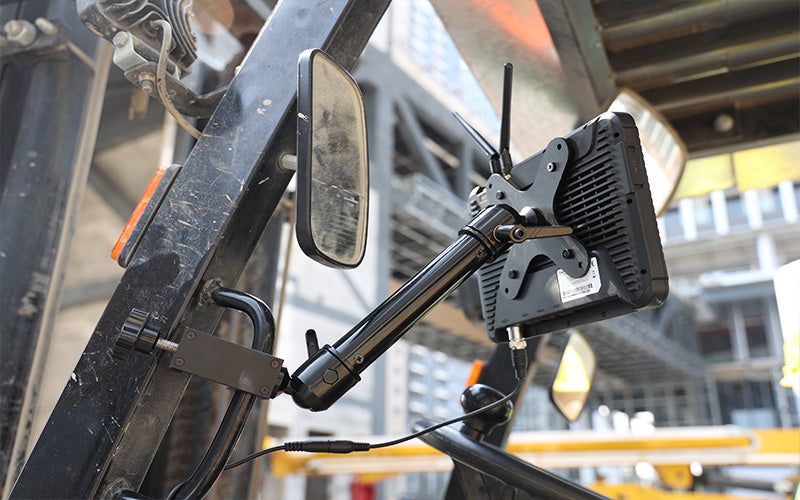
Material handling environments require reinforced vehicle systems. A forklift tablet mount uses reinforced brackets and heavy-duty clamp structures designed for severe vibration and overhead impacts. These systems are commonly deployed across inventory transfer, warehouse management, cross-docking, and material handling operations.

What Features Matter for Rugged Truck Tablets and Mounts
When sourcing transportation equipment, the tablet and mounting hardware should be evaluated together.
MIL-STD-810H Durability: Truck environments generate continuous vibration. Both the mount and tablet should support industrial shock resistance standards.
IP65 Protection (Cross-Docking Realities): Why is IP65 the benchmark rather than standard consumer water resistance? In active warehouse transfer and cross-docking operations, tablets are constantly exposed to fine concrete dust kicked up by forklifts and sudden rain during outdoor loading. An IP65 rugged tablet configuration ensures that micro-particles cannot penetrate the housing and short-circuit the motherboard during multi-shift operations.
High-Brightness Displays: Truck cabins experience strong sunlight. Displays around 1000+ nits improve visibility for GPS and dispatch applications.
Hot-Swappable Battery: Fleet operations often run multiple shifts. Hot-swappable batteries support uninterrupted operation without shutting down applications.
Best Rugged Tablet Mount Setup for Fleet Management
For most transportation fleets, the recommended layout is a modular installation chain to eliminate equipment downtime:
Vehicle Base ->Double Ball Arm -> Locking Vehicle Dock -> Rugged Tablet
This configuration improves vibration resistance, charging stability, positioning flexibility, and compatibility across different truck models. Many fleets standardize this setup across multiple vehicle platforms.

Truck Tablet Mount vs. Consumer Tablet Holder (Comparison Guide)
| Feature | Commercial Rugged Mount | Consumer Holder |
| Material Build | Aluminum or Steel | Plastic |
| Vibration Resistance | Industrial Grade | Limited |
| Charging Integration | Integrated Dock | USB Cable |
| Device Security | Locking Support | Spring Clamp |
| Durability | Heavy Duty | Consumer Use |
| Compatibility | Rugged Tablets | Standard Tablets |
Our Recommended Rugged Tablets for Transportation Operations
Selecting a reliable mounting system is only half of the deployment process. Transportation fleets also require mobile terminals capable of surviving vibration, outdoor environments, and continuous vehicle operation.
As an experienced rugged tablet manufacturer and vehicle-mounted computer supplier, we provide Android and Windows platforms engineered specifically for transportation and logistics environments. Our rugged tablets combine MIL-STD-810H durability, IP65 protection, integrated GPS, sunlight-readable displays, and dedicated pogo-pin vehicle dock compatibility to create a complete hardware ecosystem.
This one-stop approach helps fleet operators standardize hardware across dispatch operations, ELD logging, warehouse transfers, and field transportation workflows while reducing maintenance complexity and equipment downtime.
Typical deployment scenarios include:
-
Truck dispatch operations and fleet management systems
-
Warehouse transportation and cross-docking workflows
-
Delivery fleets and utility field operations
For enterprise projects, OEM / ODM customization, vehicle docking integration, and regional deployment support are also available.
Frequently Asked Questions (FAQ)
1: What is the best tablet mount for truck drivers?
Heavy-duty dashboard mounts and seat bolt systems generally provide the best stability for commercial truck environments.
2. Can rugged tablets be mounted inside trucks?
Yes. Rugged tablets often support dedicated vehicle docks with charging and locking mechanisms.
3. What tablet size is best for truck fleets?
Most fleets prefer 8-inch to 10-inch displays because they balance visibility and cabin space.
4. Do truck tablet mounts support vibration resistance?
Professional fleet mounts are designed to reduce vibration and improve device stability.
5. What rugged tablet works best with ELD and GPS systems?
Rugged Android and Windows tablets with GPS modules and cellular connectivity are commonly deployed for ELD and dispatch operations.
6. Are vehicle-mounted tablets suitable for logistics and transportation fleets?
Yes. Vehicle-mounted systems seamlessly support real-time dispatch, GPS navigation, warehouse transfer data, and digital proof-of-delivery workflows.
Conclusion
For transportation fleets, selecting the right mount is just as important as selecting the tablet. Vibration resistance, charging integration, visibility, and durability often have a greater long-term impact than hardware specifications alone.
As digital workflows continue expanding across logistics and transportation industries, vehicle-mounted rugged systems are becoming standard infrastructure for dispatch, ELD, warehouse, and field operations.
![9 Best Rugged Tablet Brands for Warehousing & Field Work [2026 Guide]](http://store.onerugged.com/cdn/shop/articles/IMG20260408152220_a5aba1e9-8a97-4d1e-9b2e-4171a9ca4736.jpg?v=1778995349&width=3072)


Leave a comment
This site is protected by hCaptcha and the hCaptcha Privacy Policy and Terms of Service apply.